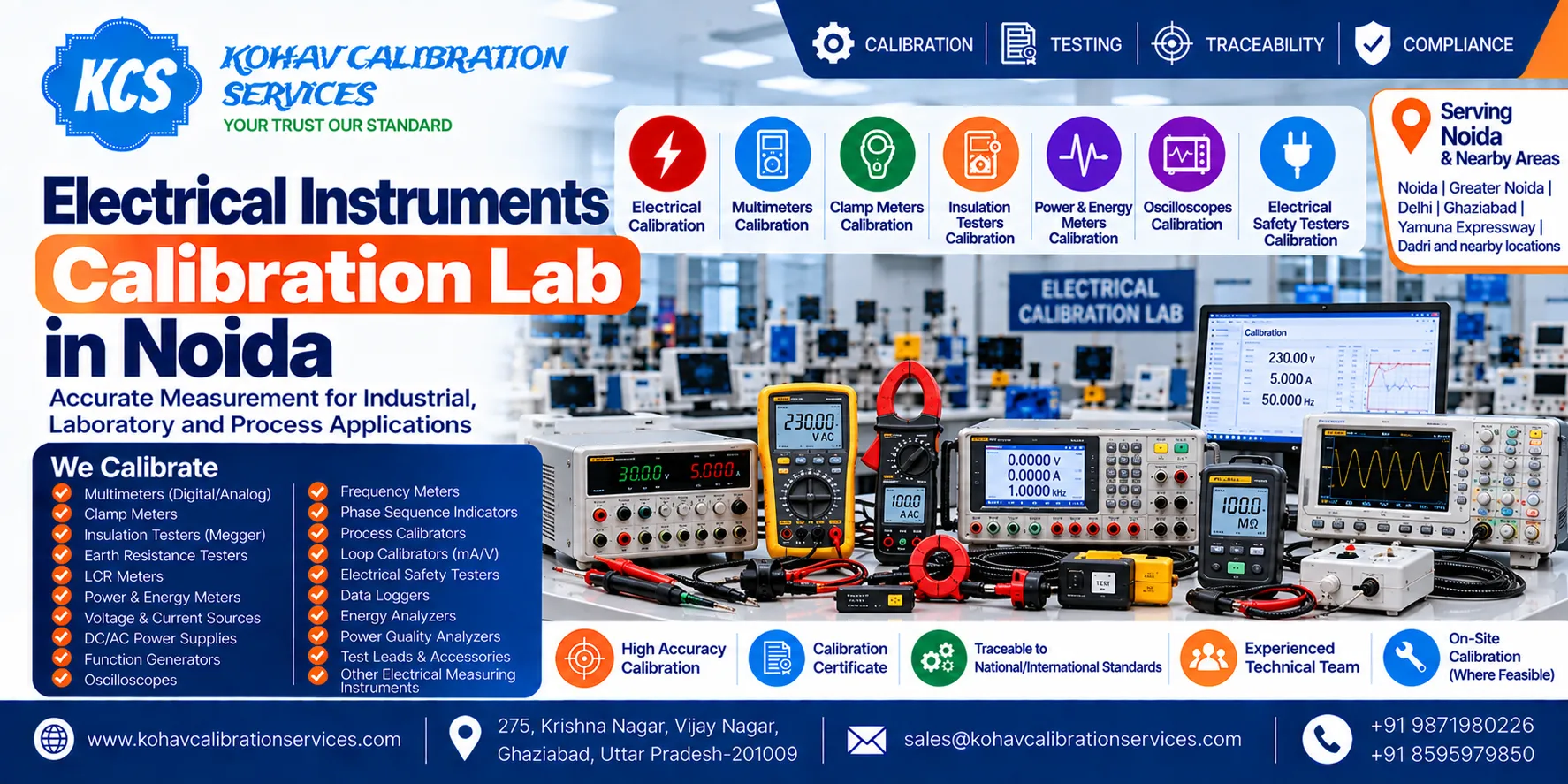
Kohav Calibration Services provides professional electrical instruments calibration services in Noida for manufacturing companies, electronics industries, engineering organizations, laboratories, testing facilities, production units, maintenance departments and quality-control teams that depend on accurate electrical measurements.
Electrical measuring instruments are essential for testing, inspection, production, maintenance, commissioning, troubleshooting and quality assurance. With regular use, electrical instruments can experience measurement drift, component aging, environmental effects or other changes that may affect measurement performance.
Periodic calibration helps organizations evaluate the measurement performance of their instruments against suitable reference standards and maintain documented measurement results.
For businesses searching for an Electrical Instruments Calibration Lab in Noida, Kohav Calibration Services focuses on instrument-specific calibration requirements, controlled measurement practices, appropriate reference standards, calibration documentation and technical support.
What Is Electrical Instrument Calibration?
Electrical instrument calibration is a controlled process of comparing an instrument’s measurement indication with an appropriate reference standard under defined conditions.
The objective is to establish the relationship between the instrument indication and the reference value and document the relevant measurement results.
Depending on the instrument and its intended application, electrical calibration may involve parameters such as:
- AC Voltage
- DC Voltage
- AC Current
- DC Current
- Resistance
- Capacitance
- Frequency
- Power
- Energy
- Power Factor
- Insulation Resistance
- Earth Resistance
- Electrical Continuity
Calibration is different from repair or adjustment. Calibration determines measurement performance, while adjustment or repair changes an instrument’s performance where technically possible and appropriate.
Electrical Instruments Calibration Services in Noida
Kohav Calibration Services can support calibration requirements for a range of electrical and electronic measuring instruments, subject to the applicable technical capability, measurement range and calibration scope.
Common electrical instruments may include:
- Digital Multimeters
- Analog Multimeters
- Clamp Meters
- AC Voltmeters
- DC Voltmeters
- AC Ammeters
- DC Ammeters
- Insulation Resistance Testers
- Megohmmeters
- Earth Resistance Testers
- Electrical Safety Testers
- LCR Meters
- Resistance Meters
- Capacitance Meters
- Frequency Meters
- Power Meters
- Energy Meters
- Wattmeters
- Power Factor Meters
- Electrical Calibrators
- Multifunction Calibrators
- Oscilloscopes
- Tachometers
- Digital Panel Meters
- Process Indicators
- Other electrical and electronic measuring equipment
The exact instruments, measurement parameters and ranges available for calibration should be confirmed against the applicable technical capability and scope.
Electrical Measurement Calibration in Noida
Accurate electrical measurement is important for manufacturing, electronics, engineering, maintenance, testing and quality-control applications.
Different instruments measure different electrical parameters, and each instrument requires an appropriate calibration method and suitable reference standards.
Common electrical calibration parameters include:
- AC Voltage
- DC Voltage
- AC Current
- DC Current
- Resistance
- Capacitance
- Frequency
- Electrical Power
- Electrical Energy
- Power Factor
- Insulation Resistance
- Earth Resistance
- Electrical Continuity
The applicable calibration points and measurement ranges depend on the instrument specification, required accuracy and intended application.
Digital Multimeter Calibration in Noida
Digital multimeters are widely used for measuring voltage, current, resistance and other electrical parameters.
They are commonly used in manufacturing facilities, electronics companies, engineering departments, laboratories, maintenance operations and quality-control environments.
Regular calibration can help determine whether the multimeter’s indication remains within the required measurement limits.
Multimeter calibration requirements may include:
- AC voltage measurement
- DC voltage measurement
- AC current measurement
- DC current measurement
- Resistance measurement
- Frequency measurement
- Other applicable functions
The exact calibration parameters and ranges should be determined according to the specific multimeter model and customer requirement.
Clamp Meter Calibration in Noida
Clamp meters are commonly used for electrical current measurement without disconnecting the conductor.
They are widely used by electrical maintenance teams, engineers, technicians and testing personnel.
Calibration of a clamp meter should use suitable reference equipment and a controlled procedure appropriate to the instrument’s measurement principle, current range and required accuracy.
Insulation Resistance Tester Calibration
Insulation resistance testers, often referred to as megohmmeters or meggers, are used to measure insulation resistance in electrical equipment and systems.
These instruments may operate over high resistance ranges and therefore require suitable reference standards and calibration procedures.
Organizations using insulation resistance testers should ensure that the selected calibration service covers the required measurement range and parameter.
Earth Resistance Tester Calibration
Earth resistance testers are used for evaluating grounding and earthing systems in electrical installations.
Reliable earth-resistance measurement can be important for electrical inspection, maintenance and verification activities.
Calibration requirements should be determined according to the tester’s measurement principle, range, accuracy specification and intended application.
Electrical Safety Tester Calibration
Electrical safety testers can be used for different safety-related electrical measurements depending on their configuration and application.
These may include tests related to insulation resistance, leakage current, high-voltage testing and other electrical safety parameters.
Because such instruments may be used for safety-related testing, their measurement performance should be controlled according to applicable specifications, procedures and organizational requirements.
Power and Energy Meter Calibration
Power meters and energy meters are used to measure electrical power and energy in industrial, commercial, testing and monitoring applications.
Depending on the instrument, calibration may involve:
- Voltage
- Current
- Power
- Energy
- Frequency
- Power factor
The calibration requirement should be established according to the meter type, measurement range, accuracy specification and intended application.
Why Electrical Instrument Calibration Is Important
Reliable electrical measurement supports quality control, testing, maintenance and engineering decisions.
An electrical instrument with measurement deviation can produce results that differ from the reference value and may affect inspection, testing or equipment evaluation.
Regular calibration can help organizations:
- Maintain confidence in electrical measurements
- Identify measurement deviations
- Detect instrument drift
- Support electrical testing
- Maintain calibration records
- Improve measurement consistency
- Support quality-control activities
- Meet customer requirements
- Support internal and external audits
- Establish measurement traceability where applicable
- Improve measuring-equipment management
Calibration is therefore an important element of a controlled measurement-management system.
Electrical Instrument Calibration Process at Kohav Calibration Services
A professional calibration process should be systematic, controlled and appropriate for the instrument and measurement parameter.
1. Instrument Identification
The instrument is identified using information such as manufacturer, model number, serial number, asset number, measurement range and instrument type.
2. Visual and Functional Inspection
The physical condition and basic functionality of the instrument may be checked before calibration.
Conditions such as damaged cables, connectors, displays, switches or other visible defects may need attention before calibration.
3. Reference Standard Selection
Appropriate reference standards are selected according to the electrical parameter, measurement range, accuracy requirement and applicable calibration procedure.
4. Controlled Measurement
The instrument is evaluated at defined measurement points and compared with applicable reference values.
5. Evaluation of Results
The measurement results are evaluated to determine applicable error, deviation, correction or other relevant information.
6. Calibration Documentation
The applicable calibration results are recorded in the relevant calibration report or certificate.
7. Calibration Status
Calibration status and records can be maintained to help organizations manage their measuring equipment and future calibration requirements.
Electrical Calibration Certificate
A calibration certificate should clearly identify the instrument and provide relevant information about the calibration performed.
Depending on the applicable service and reporting requirements, calibration documentation may include:
- Instrument name
- Manufacturer
- Model number
- Serial number
- Asset identification
- Measurement range
- Calibration date
- Calibration results
- Reference standards
- Measurement conditions
- Measurement uncertainty, where applicable
- Traceability information, where applicable
- Calibration method or procedure
- Relevant observations
Customers should verify that the reported measurement parameter and range correspond to their actual calibration requirement.
Measurement Traceability in Electrical Calibration
Measurement traceability is important when an electrical measurement result needs to be related to an appropriate reference through a documented chain of calibrations.
Reference standards used for electrical calibration should be suitable for the measurement parameter, range and required accuracy.
The applicable traceability statement should correspond to the actual reference standards, calibration procedure and technical scope used for the service.
Organizations should verify a calibration provider’s specific accreditation scope and technical capability rather than assuming that every electrical parameter or measurement range is automatically covered.
On-Site Electrical Instrument Calibration in Noida
Some electrical instruments are installed within production lines, electrical panels, testing systems or industrial equipment and may be inconvenient to transport.
Where technically appropriate, on-site electrical instrument calibration in Noida can reduce transportation requirements and help minimize equipment downtime.
On-site calibration may be considered for instruments that are:
- Permanently installed
- Integrated into production equipment
- Large or difficult to transport
- Used continuously
- Sensitive to transportation
- Required at the customer’s operating location
The feasibility of on-site calibration depends on the instrument, measurement parameter, required uncertainty, environmental conditions, reference standards and applicable calibration procedure.
Industries Requiring Electrical Calibration in Noida
Electrical measuring instruments are used across numerous industrial and commercial sectors.
Kohav Calibration Services can support electrical calibration requirements for organizations operating in areas such as:
Electronics Manufacturing
Electronics manufacturers use digital multimeters, oscilloscopes, resistance meters, frequency meters and other equipment for production testing and quality control.
Electrical Manufacturing
Electrical equipment manufacturers use voltage, current, resistance, power and other measuring instruments during production and inspection.
Automotive and Auto Components
Automotive manufacturing and component facilities may use electrical measuring instruments for testing, inspection and production verification.
Engineering Industries
Engineering organizations use electrical measurement equipment for testing, commissioning, maintenance and troubleshooting.
Manufacturing Plants
Industrial production facilities use electrical instruments for equipment maintenance, process verification and quality-control activities.
Laboratories and Testing Facilities
Testing laboratories require controlled measuring equipment and appropriate calibration records to maintain confidence in measurement results.
Industrial Automation
Automation and instrumentation departments use electrical measuring equipment for commissioning, signal verification and troubleshooting.
Electrical Maintenance
Maintenance departments use multimeters, clamp meters, insulation testers and earth resistance testers for electrical inspection and maintenance.
Electrical Calibration Services for Noida Industrial Areas
Noida is an important industrial and technology hub within the Delhi NCR region, with manufacturing, electronics, engineering, automation and commercial organizations requiring reliable measurement equipment.
Kohav Calibration Services can support organizations searching for electrical instruments calibration services in Noida, subject to the applicable service capability and technical requirement.
Calibration requirements may arise around industrial and commercial locations including:
- Sector 10
- Sector 16
- Sector 57
- Sector 58
- Sector 59
- Sector 60
- Sector 63
- Sector 64
- Sector 65
- Sector 67
- Other industrial and commercial areas of Noida
For organizations selecting a calibration provider, location is only one factor. Technical capability, measurement range, reference standards, calibration procedures, documentation, traceability and applicable accreditation scope should also be considered.
How Often Should Electrical Instruments Be Calibrated?
There is no universal calibration interval for every electrical measuring instrument.
Calibration frequency may depend on:
- Manufacturer recommendations
- Frequency of use
- Instrument stability
- Previous calibration history
- Operating environment
- Required measurement accuracy
- Measurement criticality
- Customer specifications
- Regulatory requirements
- Internal quality procedures
Organizations can review historical calibration results and instrument performance to establish appropriate calibration intervals.
Calibration vs Adjustment
Calibration and adjustment are different activities.
Calibration determines and documents the relationship between the instrument indication and the applicable reference value.
Adjustment changes the instrument’s performance so that its indication may be brought closer to a desired value, where technically possible and appropriate.
Therefore, calibration does not automatically mean that an instrument has been adjusted or repaired.
If an instrument is found outside the applicable acceptance criteria, adjustment, repair or replacement may be considered according to the customer’s procedures.
Why Choose Kohav Calibration Services?
When selecting an Electrical Instruments Calibration Lab in Noida, organizations should consider technical capability, measurement range, reference standards, calibration procedures, documentation and applicable accreditation scope.
Kohav Calibration Services focuses on:
- Professional electrical calibration support
- Instrument-specific calibration requirements
- Controlled measurement practices
- Electrical measurement documentation
- Calibration record management
- Measurement-focused technical assistance
- Industrial and commercial calibration requirements
- Laboratory and on-site service options where technically applicable
- Support for organizations across Noida and surrounding NCR areas
Our objective is to help organizations maintain reliable electrical measuring equipment and make measurement-related decisions using documented calibration results.
What Information Is Required for Electrical Instrument Calibration?
To evaluate a calibration requirement, customers should ideally provide:
- Instrument name
- Manufacturer
- Model number
- Serial number
- Asset or identification number
- Measurement parameter
- Measurement range
- Resolution
- Accuracy specification
- Quantity
- On-site or laboratory requirement
- Specific standard or reporting requirement, if applicable
Complete instrument information helps determine the appropriate technical and service requirements before calibration.
Frequently Asked Questions
What is an electrical instruments calibration lab in Noida?
An electrical instruments calibration lab in Noida is a calibration facility that evaluates electrical measuring instruments by comparing their indications with appropriate reference standards under defined conditions and documenting the resulting measurement information.
Which electrical instruments can be calibrated in Noida?
Depending on the calibration provider’s technical capability and applicable scope, electrical calibration may include digital multimeters, clamp meters, insulation resistance testers, earth resistance testers, LCR meters, power meters, energy meters, frequency meters, resistance meters and other electrical measuring equipment.
Why is electrical instrument calibration necessary?
Calibration helps determine measurement error or deviation and provides documented information about an instrument’s measurement performance. It can support electrical testing, quality control, maintenance, audits, equipment management and measurement traceability.
How often should electrical instruments be calibrated?
The calibration interval depends on the instrument, application, measurement accuracy, operating environment, manufacturer’s recommendations, previous calibration history and applicable quality or regulatory requirements.
Can electrical instruments be calibrated on-site in Noida?
For suitable instruments and applications, on-site calibration may be possible. Feasibility depends on the instrument, measurement parameter, required uncertainty, environmental conditions, reference standards and applicable calibration procedure.
Does calibration repair an electrical instrument?
No. Calibration determines and documents measurement performance. Repair or adjustment is a separate activity that may be required when an instrument does not meet the applicable acceptance requirements.
What should I check before selecting an electrical calibration laboratory in Noida?
Check whether the provider has the required technical capability, measurement range, suitable reference standards, documented procedures, traceability information and applicable accreditation scope for your specific instrument and measurement parameter.
What information is required for an electrical calibration quotation?
Provide the instrument name, manufacturer, model, measurement range, required measurement parameter, quantity and whether laboratory or on-site calibration is required. Additional technical information may be requested depending on the instrument.
How can I get electrical instrument calibration services in Noida?
Contact Kohav Calibration Services with your instrument details and calibration requirements. The requirement can be reviewed to determine the applicable calibration service, documentation and quotation.
Get Electrical Instrument Calibration Support in Noida
If you are searching for an Electrical Instruments Calibration Lab in Noida, Kohav Calibration Services can assist with electrical measurement and calibration requirements based on your instrument type, measurement parameter, measurement range and intended application.
Whether you require calibration for digital multimeters, clamp meters, insulation resistance testers, earth resistance testers, LCR meters, power meters, energy meters or other electrical measuring equipment, the appropriate calibration service should be determined according to the instrument and applicable technical scope.
Contact Kohav Calibration Services with your instrument details to discuss the calibration requirement, service method, documentation and quotation.
Kohav Calibration Services
Electrical Instrument Calibration Services in Noida
Electrical Measurement | Calibration Documentation | Technical Support | Traceability Where Applicable