- H. NO. 275, Krishna Nagar, Bhim Nagar, Vijay Nagar, Ghaziabad, Uttar Pradesh 201009
- +91 9871980226
Mass & Volume Calibration
- Home
- Mass & Volume Calibration
Calibration Services
Get Started Today
- +91 98719 80226
- sales@kohavcalibrationservices.com
- H. NO. 275, Krishna Nagar, Bhim Nagar, Vijay Nagar, Ghaziabad, Uttar Pradesh 201009
Contact with us for any advice
Need help? Talk to an expert
+91 98719 80226
Professional Mass & Volume Calibration Services
Accurate mass and volume measurements are essential for quality control, production, laboratory testing, manufacturing, healthcare, and various industrial applications. Kohav Calibration Services Private Limited provides professional Mass & Volume Calibration Services to help organizations maintain the accuracy, reliability, and consistency of their weighing and volume measurement instruments.
Our calibration services help identify measurement deviations and provide greater confidence in the performance of instruments used for mass and volume measurements.
Reliable Calibration for Mass & Volume Measuring Instruments
Accurate weighing and volume measurement can directly affect product quality, material consumption, testing results, and process efficiency. Factors such as frequent use, environmental conditions, handling, and equipment aging can influence instrument performance over time.
At Kohav Calibration Services, we provide systematic calibration support for applicable mass and volume measuring instruments according to their type, range, resolution, application, and calibration requirements.
Mass & Volume Instruments We Calibrate
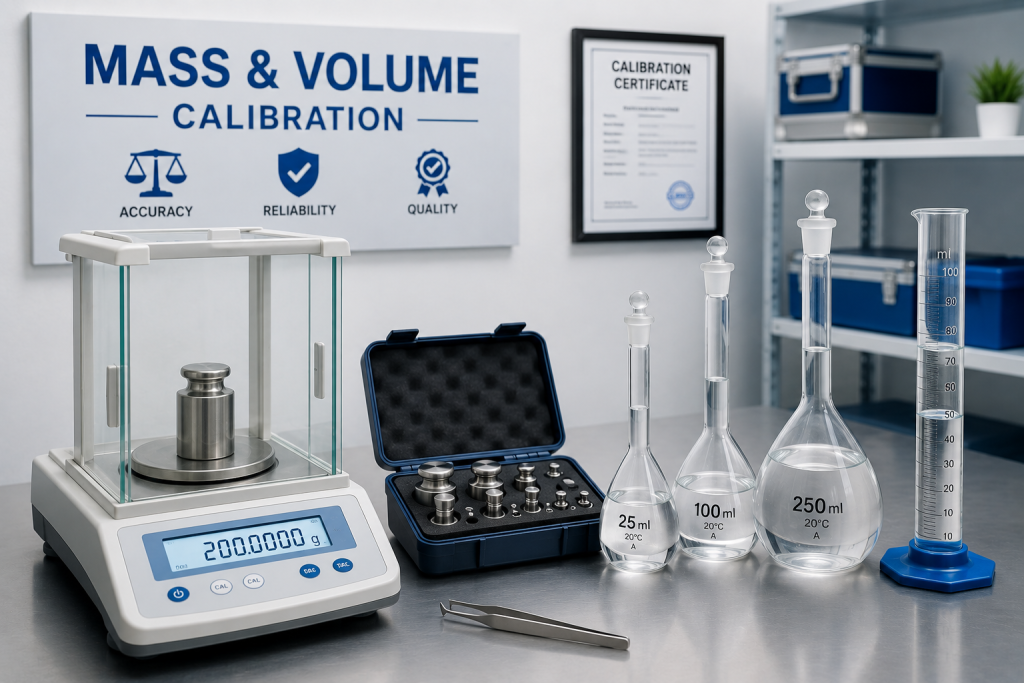
Our calibration services can cover various measuring and weighing instruments, including:
- Weighing Balances
- Digital Weighing Scales
- Analytical Balances
- Platform Weighing Scales
- Standard Weights
- Test Weights
- Measuring Cylinders
- Volumetric Flasks
- Pipettes
- Burettes
- Measuring Containers
- Other Applicable Mass & Volume Measuring Equipment
The applicable calibration method and reference standards may vary depending on the instrument, measurement range, accuracy requirements, and intended application.
Why Mass & Volume Calibration Is Important
Accurate mass and volume measurements are important wherever materials, ingredients, samples, or products need to be measured precisely. Even small measurement deviations can affect production processes, laboratory results, inventory calculations, and quality control.
Regular Mass & Volume Calibration can help organizations:
- Maintain measurement accuracy
- Identify measurement deviations
- Improve weighing reliability
- Support consistent quality control
- Reduce measurement-related errors
- Maintain proper calibration records
- Improve confidence in measurement results
- Support applicable quality requirements
Our Mass & Volume Calibration Process
Instrument Identification
The instrument is received and relevant details such as identification, capacity, range, resolution, and other available information are recorded.
Visual & Functional Inspection
The equipment is inspected for its general condition and functional suitability before calibration.
Calibration & Measurement
The instrument is evaluated using appropriate reference standards and procedures applicable to its measurement characteristics.
Result Evaluation
Observed readings are reviewed to determine measurement performance and identify any applicable deviation.
Documentation
Calibration results and relevant instrument information are documented according to the applicable service and customer requirements.
Instrument Delivery
After completion of the calibration process, the instrument is prepared for safe return to the customer.
Benefits of Professional Mass & Volume Calibration
Regular calibration helps organizations maintain greater confidence in their weighing and volume measurement activities. Properly calibrated equipment can support better quality control, consistent production processes, accurate laboratory measurements, and dependable decision-making.
Calibration can also help identify instruments that may require adjustment, maintenance, or further evaluation due to measurement deviations.
Industries We Serve
Our mass and volume calibration services can support organizations across various sectors, including:
- Manufacturing Industries
- Pharmaceutical Industries
- Food & Beverage Industries
- Chemical Industries
- Healthcare & Medical Facilities
- Laboratories
- Research & Development
- Engineering Industries
- Quality Control Departments
- Testing Facilities
- Process Industries
Why Choose Kohav Calibration Services?
Accuracy-Focused Approach
We focus on reliable measurement evaluation and dependable calibration results.
Professional Calibration Support
Our services follow a systematic approach based on instrument characteristics and customer requirements.
Wide Range of Instruments
We support calibration requirements for various mass, weighing, and volume measurement equipment.
Reliable Documentation
Relevant calibration information and results are documented to support customer record-keeping.
What is mass calibration?
Mass calibration is the process of evaluating the accuracy of weighing instruments or standard weights against appropriate reference standards to identify measurement deviations.
What is volume calibration?
Volume calibration involves evaluating the measurement accuracy of volumetric instruments and equipment used to measure liquids or other volumes.
Which mass and volume instruments can be calibrated?
Depending on the applicable calibration capability and requirements, weighing balances, digital scales, standard weights, measuring cylinders, volumetric flasks, pipettes, burettes, and other measuring equipment can be considered.
Why should weighing instruments be calibrated regularly?
Regular calibration helps identify measurement deviations and provides greater confidence in weighing accuracy, quality control, and measurement results.
How often should mass and volume instruments be calibrated?
Calibration intervals depend on factors such as instrument usage, operating conditions, manufacturer’s recommendations, previous calibration history, and organizational quality requirements.