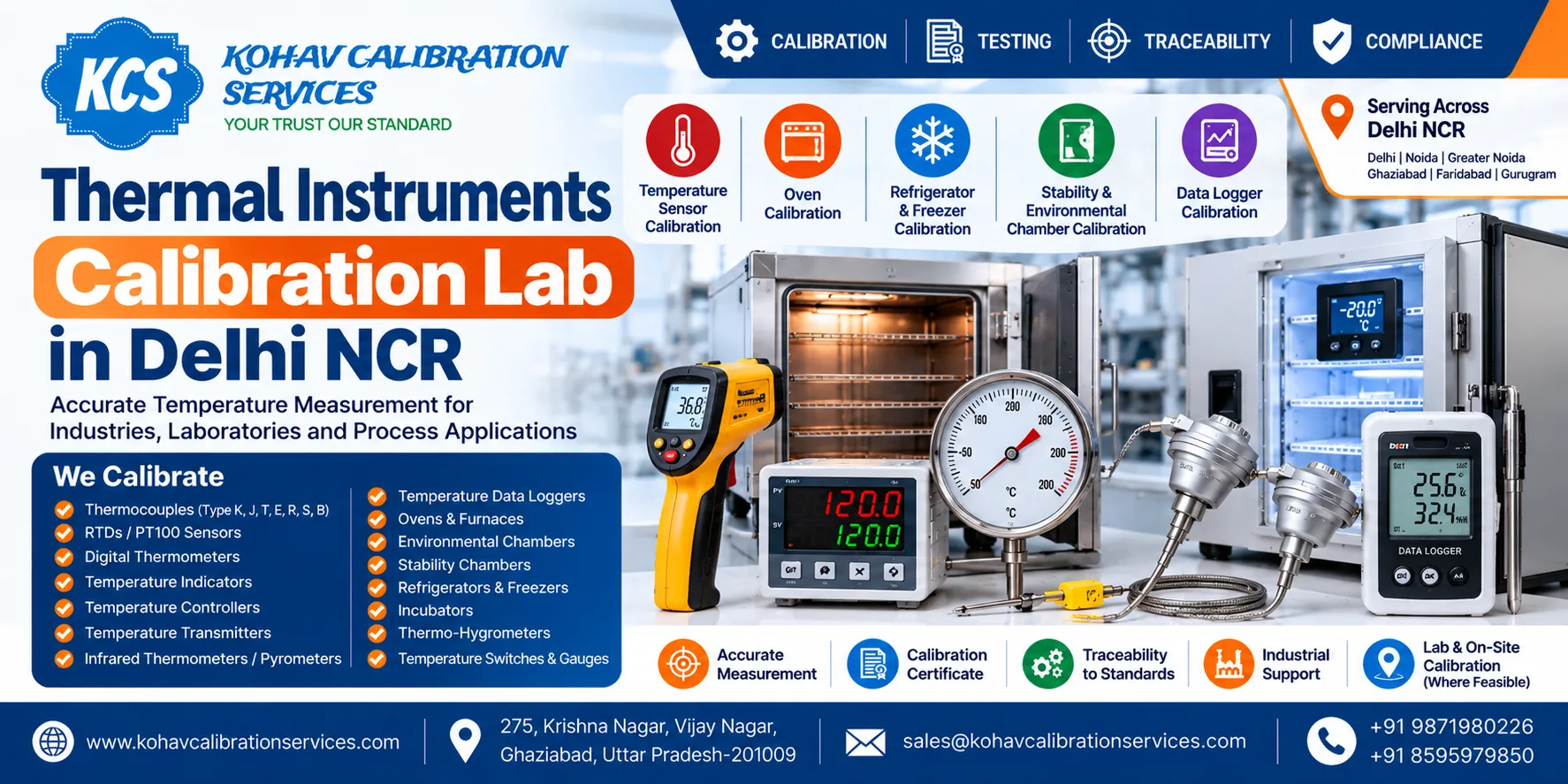
Kohav Calibration Services provides professional Thermal Instruments Calibration Lab in Delhi NCR services for temperature measuring instruments, sensors, controllers, indicators, data loggers, thermocouples, RTDs, thermometers and other thermal measurement equipment.
Accurate temperature measurement is essential across pharmaceutical manufacturing, food processing, chemical industries, healthcare, laboratories, HVAC, cold-chain operations, manufacturing and research facilities. Even small temperature measurement errors can affect product quality, process control, storage conditions and laboratory results.
Kohav Calibration Services supports thermal calibration requirements across Delhi NCR, with the applicable service determined by instrument type, temperature range, accuracy requirement, measurement parameter and available technical capability.
What Is Thermal Instrument Calibration?
Thermal instrument calibration is the process of comparing the measurement performance of temperature and thermal instruments against suitable reference standards.
Depending on the equipment, thermal calibration may involve:
- Temperature
- Temperature difference
- Resistance temperature measurement
- Thermocouple output
- RTD measurement
- Temperature indication
- Temperature recording
- Thermal chamber performance
- Furnace temperature
- Oven temperature
- Humidity and temperature measurement where applicable
The purpose of calibration is to determine measurement performance and provide documented results for quality-control and measurement-management purposes.
Thermal Instruments Calibration Services in Delhi NCR
Kohav Calibration Services can support calibration requirements for a wide range of thermal instruments, subject to applicable technical capability and scope.
Common thermal instruments include:
- Digital thermometers
- Digital temperature indicators
- Temperature controllers
- Temperature transmitters
- Temperature sensors
- RTD sensors
- PT100 sensors
- Thermocouples
- Infrared thermometers
- Temperature data loggers
- Temperature recorders
- Thermo-hygrometers
- Temperature gauges
- Temperature switches
- Dry block calibrators
- Temperature baths
- Ovens
- Furnaces
- Environmental chambers
- Stability chambers
- Refrigerators
- Freezers
- Deep freezers
- Cold rooms
- Other thermal measurement equipment
The exact temperature range and calibration capability should be confirmed for the specific instrument before service.
Temperature Calibration in Delhi NCR
Temperature calibration is used to verify whether a thermometer, sensor, indicator or other temperature-measuring device provides accurate readings within the required range.
Depending on the instrument, calibration can involve comparison against an appropriate reference standard under controlled conditions.
Temperature calibration may be required for:
- Process monitoring
- Laboratory testing
- Pharmaceutical manufacturing
- Food processing
- Cold storage
- Healthcare
- HVAC systems
- Chemical processing
- Research applications
- Quality-control operations
Thermocouple Calibration in Delhi NCR
Thermocouples are widely used for industrial temperature measurement because they can operate across a broad range of temperatures.
Common thermocouple types include:
- Type K
- Type J
- Type T
- Type E
- Type N
- Type R
- Type S
- Type B
Calibration requirements depend on thermocouple type, temperature range, construction, reference standards and applicable procedure.
Thermocouple calibration can help determine the relationship between the sensor output and the corresponding reference temperature.
RTD and PT100 Calibration
RTDs, including PT100 sensors, are widely used where stable and accurate temperature measurement is required.
Applications include:
- Pharmaceutical processes
- Food processing
- Chemical plants
- Laboratories
- HVAC
- Process industries
- Temperature-controlled equipment
Calibration can evaluate the sensor’s measurement performance across selected temperature points according to the applicable procedure.
Digital Thermometer Calibration
Digital thermometers are used in laboratories, production areas, healthcare facilities, food processing and temperature-controlled storage.
Calibration may verify:
- Displayed temperature
- Measurement error
- Repeatability
- Selected calibration points
- Applicable measurement uncertainty
The calibration range depends on the thermometer design and available technical capability.
Infrared Thermometer Calibration
Infrared thermometers provide non-contact temperature measurements and are commonly used in manufacturing, healthcare, food processing, maintenance and industrial applications.
Calibration may involve comparison against an appropriate temperature reference source.
Important considerations include:
- Temperature range
- Emissivity
- Distance-to-spot ratio
- Measurement geometry
- Reference source
- Environmental conditions
The applicable procedure depends on the instrument and required measurement range.
Temperature Data Logger Calibration
Temperature data loggers are commonly used for monitoring:
- Pharmaceutical storage
- Vaccine storage
- Cold-chain transportation
- Warehouses
- Laboratories
- Refrigerators
- Freezers
- Environmental conditions
- Production processes
Calibration helps establish whether recorded temperature values correspond appropriately with reference measurements.
Temperature Indicator and Controller Calibration
Temperature indicators and controllers are used in industrial processes and temperature-controlled equipment.
Calibration may involve checking:
- Display indication
- Sensor input
- Controller indication
- Selected temperature points
- Measurement error
- Relevant output or control parameters where included in the procedure
Calibration requirements depend on the controller type and intended application.
Oven Calibration in Delhi NCR
Industrial and laboratory ovens require reliable temperature measurement for controlled heating processes.
Applications can include:
- Pharmaceutical manufacturing
- Food processing
- Electronics
- Chemical industries
- Material testing
- Laboratories
- Industrial manufacturing
Oven temperature calibration may involve checking temperature at selected locations or measurement points according to the applicable procedure.
Furnace Temperature Calibration
Industrial furnaces operate at elevated temperatures and require suitable measurement systems for process control.
Calibration may involve:
- Thermocouples
- Temperature indicators
- Temperature controllers
- Reference sensors
- Furnace temperature measurement systems
The applicable temperature range and reference standards must be appropriate for the furnace operating conditions.
Environmental Chamber Calibration
Environmental chambers are used to create controlled temperature and humidity conditions for testing, storage and research.
Calibration or mapping-related services may include evaluation of:
- Temperature
- Humidity
- Uniformity
- Stability
- Sensor indication
- Data logging
The exact service depends on whether the requirement is instrument calibration, chamber mapping, validation or performance qualification.
Stability Chamber Temperature Calibration
Stability chambers are widely used in pharmaceutical and research environments.
Temperature calibration and related measurement verification can support:
- Controlled storage
- Stability studies
- Pharmaceutical testing
- Research applications
- Quality-control processes
Where chamber mapping or qualification is required, it should be treated as a distinct technical service from simple sensor calibration.
Refrigerator and Freezer Temperature Calibration
Temperature-controlled refrigerators and freezers are used in:
- Pharmaceutical facilities
- Hospitals
- Laboratories
- Blood banks
- Food industries
- Research facilities
- Cold-chain operations
Calibration of temperature sensors and monitoring instruments can help establish confidence in recorded storage temperatures.
Deep Freezer Calibration
Deep freezers operate at low temperatures and require temperature measurement systems suitable for their operating range.
Calibration may be required for:
- Digital temperature indicators
- Temperature sensors
- Data loggers
- Monitoring systems
- Reference thermometers
The required calibration range should cover the intended operating temperature of the equipment.
Thermal Calibration Process at Kohav
A typical thermal calibration workflow may include:
1. Instrument Identification
The equipment is identified using:
- Manufacturer
- Model
- Serial number
- Asset number
- Instrument type
- Temperature range
- Resolution
2. Visual and Functional Inspection
The instrument is checked for visible damage and basic operating condition.
3. Reference Standard Selection
A suitable reference thermometer, sensor, calibrator or other reference standard is selected according to the required temperature range and accuracy.
4. Stabilization
Where required, the instrument and reference system are allowed to stabilize at the selected calibration temperature.
5. Measurement
Measurements are taken at defined temperature points according to the applicable procedure.
6. Result Evaluation
The observed indication is compared with the reference value and applicable acceptance criteria.
7. Measurement Uncertainty
Measurement uncertainty may be evaluated and reported according to the applicable calibration procedure.
8. Calibration Documentation
The calibration results are documented in a calibration certificate or report.
9. Calibration Status
Calibration status can be identified according to the customer’s quality-management requirements.
Thermal Calibration Certificate
A thermal calibration certificate may contain:
- Customer information
- Instrument identification
- Manufacturer
- Model
- Serial number
- Calibration date
- Temperature range
- Calibration points
- Reference standard
- Observed readings
- Error or deviation
- Measurement uncertainty, where applicable
- Environmental conditions, where applicable
- Traceability information
- Applicable procedure
- Calibration status
- Authorized personnel details
The exact certificate format depends on the equipment and applicable service requirements.
Measurement Traceability for Thermal Calibration
Measurement traceability is important when temperature measurements need to be related to recognized reference standards through a documented chain of calibrations.
The traceability arrangement depends on:
- Reference standard
- Temperature range
- Calibration method
- Instrument type
- Measurement uncertainty
- Technical scope
Where accredited calibration is specifically required, customers should verify the laboratory’s current accreditation status and exact scope covering the required temperature range and instrument.
Publicly available thermal calibration facilities in India demonstrate that thermal scopes can include equipment such as PRT/RTD sensors, thermocouples, infrared thermometers, digital indicators, data loggers, dry-block calibrators and furnaces.
Environmental Conditions During Thermal Calibration
Temperature calibration can be affected by environmental and operating conditions.
Depending on the instrument and method, relevant factors can include:
- Ambient temperature
- Relative humidity
- Air movement
- Thermal stability
- Sensor placement
- Immersion depth
- Heat transfer
- Reference-source stability
- Instrument stabilization time
The applicable environmental requirements depend on the calibration method and equipment.
On-Site Thermal Calibration in Delhi NCR
Many temperature instruments are installed directly inside production processes, cold rooms, ovens, furnaces, environmental chambers and other equipment.
Transporting these instruments may be impractical or could interrupt production.
Where technically feasible, on-site thermal calibration may be considered for:
- Temperature sensors
- RTDs
- Thermocouples
- Temperature indicators
- Temperature controllers
- Ovens
- Furnaces
- Refrigerators
- Freezers
- Cold rooms
- Environmental chambers
- Stability chambers
- Temperature data loggers
The feasibility of on-site calibration depends on the equipment, required reference standards, temperature range and site conditions.
Delhi NCR calibration providers publicly advertise thermal calibration and on-site services, including calibration of temperature-related equipment.
Industries Requiring Thermal Instrument Calibration in Delhi NCR
Thermal calibration is relevant across industries where temperature measurement influences product quality, process control or testing.
Major applications include:
- Pharmaceutical industries
- Biotechnology
- Food and beverage
- Chemical industries
- Petrochemical industries
- Automotive manufacturing
- Electronics manufacturing
- Medical and healthcare facilities
- Testing laboratories
- Research laboratories
- HVAC companies
- Cold-chain logistics
- Warehousing
- Packaging industries
- Engineering industries
- Government laboratories
- Educational and R&D institutions
Thermal Calibration for Pharmaceutical Industries
Pharmaceutical manufacturing and storage can involve strict temperature-control requirements.
Thermal instruments may be used in:
- Manufacturing processes
- Stability chambers
- Warehouses
- Refrigerators
- Freezers
- Cold rooms
- Incubators
- Autoclaves
- Temperature mapping systems
Calibration helps maintain documented measurement performance for temperature-monitoring equipment.
Thermal Calibration for Food and Beverage Industries
Food processing and storage operations use temperature measurement for:
- Cooking
- Heating
- Cooling
- Pasteurization
- Refrigeration
- Freezing
- Cold storage
- Process monitoring
Accurate temperature measurement supports consistent process control and quality monitoring.
Thermal Calibration for Laboratories
Laboratories use temperature instruments for testing, sample preparation, storage and environmental control.
Common equipment includes:
- Laboratory thermometers
- RTDs
- Thermocouples
- Temperature data loggers
- Ovens
- Furnaces
- Incubators
- Refrigerators
- Freezers
- Temperature chambers
Calibration helps laboratories maintain appropriate measurement records.
Thermal Calibration Services Across Delhi NCR
Kohav Calibration Services can support thermal calibration requirements across the Delhi NCR region, subject to technical feasibility.
Service areas may include:
Delhi
- New Delhi
- Central Delhi
- South Delhi
- North Delhi
- East Delhi
- West Delhi
- Rohini
- Dwarka
- Okhla
- Patparganj
- Naraina
- Mayapuri
- Bawana
- Shahdara
- Other Delhi locations
Noida
- Sector 10
- Sector 16
- Sector 57
- Sector 58
- Sector 59
- Sector 60
- Sector 62
- Sector 63
- Sector 64
- Sector 65
- Sector 67
- Sector 80
- Sector 83
- Sector 85
- Sector 88
- Sector 90
- Other Noida locations
Ghaziabad
- Sahibabad
- Site IV Sahibabad
- Mohan Nagar
- Indirapuram
- Vasundhara
- Vaishali
- Rajendra Nagar
- Meerut Road
- Bulandshahr Road
- Loni
- Dasna
- Tronica City
- Vijay Nagar
- Other Ghaziabad locations
Greater Noida
- Surajpur
- Ecotech
- Kasna
- Knowledge Park
- Greater Noida Industrial Development Area
- Other industrial areas
Faridabad
- NIT Faridabad
- Mathura Road
- Sector 24
- Sector 25
- Sector 27
- Sector 58
- Ballabhgarh
- Other industrial areas
How Often Should Thermal Instruments Be Calibrated?
There is no universal calibration interval for every thermal instrument.
The appropriate calibration frequency may depend on:
- Instrument type
- Manufacturer recommendations
- Temperature range
- Frequency of use
- Operating environment
- Required measurement accuracy
- Previous calibration history
- Instrument stability
- Risk associated with incorrect temperature measurement
- Internal quality procedures
- Customer or regulatory requirements
Organizations should establish calibration intervals according to their quality-management system and equipment performance history.
What Happens If a Thermal Instrument Fails Calibration?
If a temperature instrument does not meet its applicable acceptance criteria, the organization should evaluate the condition and potential measurement impact.
Depending on the situation, actions may include:
- Adjustment
- Sensor replacement
- Repair
- Recalibration
- Reinspection
- Review of previous measurement results
- Evaluation of potentially affected products or processes
- Updating calibration status
The appropriate corrective action depends on the instrument and the organization’s quality procedures.
Calibration vs Adjustment
Calibration and adjustment are different activities.
Calibration determines the measurement performance of an instrument by comparison with an appropriate reference standard.
Adjustment changes the instrument’s measurement performance to meet a specified requirement.
An instrument can be calibrated without adjustment. If adjustment is performed, recalibration may be required to document the instrument’s performance after adjustment.
Calibration vs Temperature Mapping
Thermal instrument calibration and temperature mapping are related but different services.
Instrument calibration evaluates the accuracy of a specific measuring instrument or sensor against a reference.
Temperature mapping evaluates temperature distribution across a defined space such as a refrigerator, warehouse, chamber or cold room.
A facility may require both services depending on its quality and validation requirements.
Why Choose Kohav Calibration Services for Thermal Calibration?
Kohav Calibration Services focuses on measurement-oriented calibration support for industrial, laboratory and process-control equipment.
Key service considerations include:
- Thermal instrument calibration support
- Temperature sensor calibration
- Thermocouple and RTD calibration support
- Temperature indicator calibration
- Temperature data logger calibration
- On-site calibration feasibility
- Delhi NCR service coverage
- Professional calibration documentation
- Equipment-specific technical assessment
- Support for quality-control and audit documentation
The exact temperature range, calibration parameter and accreditation status should always be confirmed for the specific instrument before service.
Information Required for a Thermal Calibration Quotation
For a faster technical assessment, customers can provide:
- Instrument name
- Manufacturer
- Model number
- Serial number
- Asset number
- Sensor type
- Temperature range
- Required calibration points
- Quantity
- Current calibration certificate, if available
- Location
- On-site or laboratory requirement
- Required turnaround time
For large industrial projects, an instrument inventory can help organize multiple thermal calibration requirements.
Frequently Asked Questions
What is thermal instrument calibration?
Thermal instrument calibration is the comparison of temperature-measuring equipment with an appropriate reference standard to determine its measurement performance.
Which thermal instruments can be calibrated?
Depending on technical capability, thermal calibration may cover thermocouples, RTDs, PT100 sensors, digital thermometers, infrared thermometers, temperature indicators, controllers, data loggers and other temperature-measuring equipment.
Do you provide temperature calibration in Delhi NCR?
Kohav Calibration Services provides thermal and temperature calibration support subject to the instrument type, measurement range and applicable technical capability.
Do you calibrate thermocouples?
Thermocouple calibration can be supported subject to the thermocouple type, temperature range, reference standards and applicable technical scope.
Do you calibrate RTD and PT100 sensors?
RTD and PT100 calibration can be assessed according to the sensor type, temperature range and applicable calibration procedure.
Do you provide on-site thermal calibration?
On-site thermal calibration may be available where technically feasible. The instrument, temperature range and site conditions should be assessed before confirming the service.
Can temperature data loggers be calibrated?
Temperature data loggers can be assessed for calibration according to their measurement range, sensor type and applicable technical procedure.
What is the difference between calibration and temperature mapping?
Calibration verifies an individual measuring instrument against a reference. Temperature mapping evaluates temperature distribution throughout a defined space or equipment.
Is every thermal calibration service NABL accredited?
Accreditation is scope-specific. A laboratory may be accredited for particular thermal instruments, temperature ranges and parameters rather than every thermal calibration service. Customers requiring accredited calibration should verify the current accreditation scope before placing an order.
How often should temperature instruments be calibrated?
The interval depends on the instrument, manufacturer recommendations, usage, required accuracy, operating conditions, previous calibration history and quality-system requirements.
How can I request a thermal calibration quotation?
Provide the instrument name, manufacturer, model, sensor type, temperature range, quantity and location. Kohav Calibration Services can assess the applicable thermal calibration requirement.
Thermal Instruments Calibration Lab in Delhi NCR – Kohav Calibration Services
Reliable temperature measurement is essential for manufacturing, laboratories, pharmaceutical operations, food processing, healthcare, cold-chain management and other temperature-sensitive applications.
Kohav Calibration Services provides professional Thermal Instruments Calibration Lab in Delhi NCR support for applicable temperature instruments, including thermocouples, RTDs, PT100 sensors, digital thermometers, infrared thermometers, temperature indicators, controllers, data loggers, ovens, furnaces and other thermal measurement equipment, subject to technical capability and scope.
For thermal instrument calibration requirements in Delhi NCR, share your equipment details, temperature range, calibration points and location with Kohav Calibration Services for technical assessment and service planning.