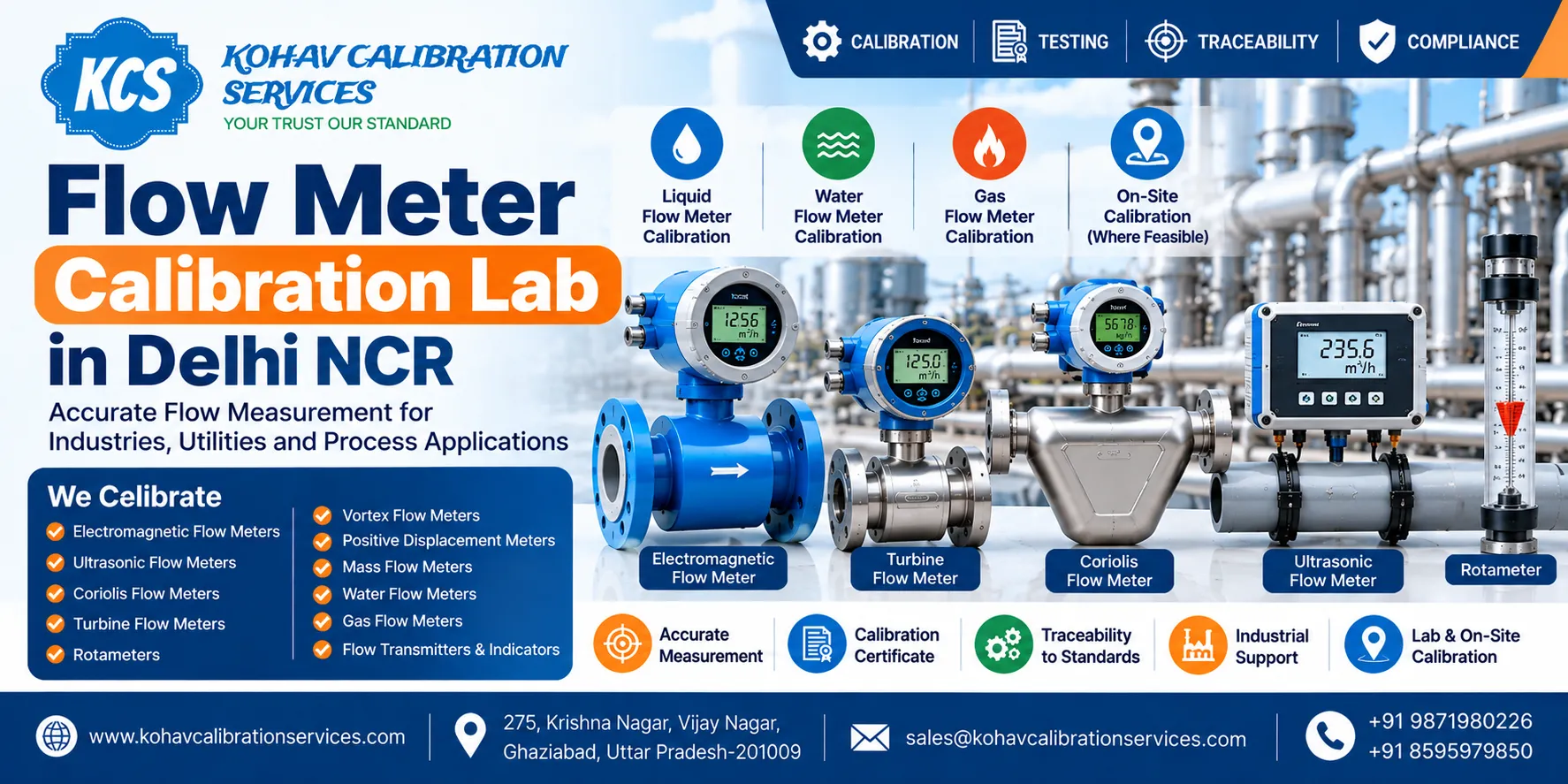
Kohav Calibration Services provides professional Flow Meter Calibration Lab in Delhi NCR services for industrial flow meters, water flow meters, gas flow meters, liquid flow meters, rotameters, electromagnetic flow meters, ultrasonic flow meters, turbine flow meters and other flow-measurement instruments.
Accurate flow measurement is essential for process control, production, water management, chemical processing, pharmaceutical manufacturing, food industries, oil and gas applications, utilities and laboratory operations.
Flow-meter measurement errors can affect material consumption, process efficiency, product quality, energy management and billing-related measurements. Regular calibration helps organizations evaluate flow-meter performance and maintain documented measurement records.
Kohav Calibration Services supports flow-meter calibration requirements across Delhi NCR, with the applicable service determined by flow-meter type, fluid, flow range, pipe size, operating conditions, accuracy requirements and available technical capability.
What Is Flow Meter Calibration?
Flow meter calibration is the process of comparing the indication or output of a flow-measuring instrument against an appropriate reference measurement system.
Depending on the flow-meter technology, calibration may evaluate:
- Flow rate
- Totalized volume
- Mass flow
- Volumetric flow
- Pulse output
- Analog output
- Digital output
- Flow-meter indication
- Repeatability
- Measurement error
- Applicable measurement uncertainty
The calibration method depends on the flow-meter technology, fluid, operating range and applicable technical procedure.
Flow Meter Calibration Services in Delhi NCR
Kohav Calibration Services can support applicable flow-meter calibration requirements for industrial and process applications.
Flow-meter categories may include:
- Electromagnetic flow meters
- Ultrasonic flow meters
- Coriolis flow meters
- Turbine flow meters
- Vortex flow meters
- Positive displacement flow meters
- Rotameters
- Variable-area flow meters
- Water flow meters
- Gas flow meters
- Air flow meters
- Liquid flow meters
- Mass flow meters
- Digital flow meters
- Mechanical flow meters
- Process flow transmitters
- Flow switches
- Flow indicators
- Other flow-measuring instruments
The exact flow range, pipe size, fluid and calibration capability should be confirmed before service.
Liquid Flow Meter Calibration in Delhi NCR
Liquid flow meters are widely used for measuring water, chemicals, process liquids and other fluids.
Applications include:
- Water treatment
- Manufacturing
- Chemical processing
- Pharmaceutical production
- Food processing
- Utilities
- Process industries
- Industrial water systems
- Cooling-water systems
Calibration may compare the flow meter against an appropriate reference system at selected flow rates.
The applicable calibration procedure depends on the meter technology, fluid properties and required flow range.
Water Flow Meter Calibration
Water flow meters are used in:
- Water-treatment plants
- Industrial utilities
- Manufacturing facilities
- Commercial buildings
- Municipal applications
- Process plants
- Cooling systems
- Water distribution systems
Water-flow calibration may involve comparison against a reference volume or reference flow measurement system.
Government technical infrastructure describes liquid flow-meter calibration facilities using controlled test rigs and defined flow ranges, demonstrating the importance of controlled flow conditions during calibration.
Gas Flow Meter Calibration in Delhi NCR
Gas flow meters are used for measurement of air, natural gas and other gases in industrial and process applications.
Gas flow-meter calibration can involve:
- Flow indication
- Flow rate
- Totalized volume
- Pulse output
- Analog output
- Measurement error
- Repeatability
The calibration method depends on the gas, operating pressure, flow range, meter technology and reference standard.
Gas-flow applications may require additional technical considerations compared with liquid-flow calibration.
Electromagnetic Flow Meter Calibration
Electromagnetic flow meters are commonly used for conductive liquids such as water and certain process fluids.
They are widely applied in:
- Water treatment
- Chemical industries
- Pharmaceutical industries
- Food processing
- Effluent treatment
- Industrial utilities
Calibration may verify the meter’s indicated flow against a suitable reference measurement.
Important factors can include:
- Flow range
- Pipe diameter
- Fluid conductivity
- Meter configuration
- Installation conditions
- Reference system
- Measurement uncertainty
Ultrasonic Flow Meter Calibration
Ultrasonic flow meters measure flow using ultrasonic measurement principles and may be used for liquid or gas applications depending on the meter design.
Calibration requirements can depend on:
- Meter technology
- Pipe size
- Fluid
- Flow range
- Sensor configuration
- Installation arrangement
- Reference standard
For installed ultrasonic flow meters, on-site verification or calibration may be considered where technically feasible.
Coriolis Flow Meter Calibration
Coriolis flow meters can measure mass flow and, depending on the instrument, may also provide density and volumetric-flow information.
Applications include:
- Chemical processing
- Pharmaceutical manufacturing
- Oil and gas
- Food processing
- Process industries
- Precision liquid measurement
Calibration requirements depend on the meter’s measurement parameters, flow range and operating conditions.
Turbine Flow Meter Calibration
Turbine flow meters are used for measuring liquids and gases in various industrial applications.
Calibration may evaluate:
- Flow rate
- Totalized flow
- Meter factor
- Repeatability
- Measurement error
The applicable procedure depends on the meter design, fluid and operating range.
Rotameter Calibration in Delhi NCR
Rotameters are variable-area flow meters used for local indication of fluid flow.
They are commonly found in:
- Laboratories
- Chemical plants
- Pharmaceutical facilities
- Water-treatment systems
- Gas systems
- Process plants
Calibration can verify the relationship between the indicated flow and the reference flow at selected points.
Vortex Flow Meter Calibration
Vortex flow meters are used for measuring liquid, gas and steam flows in process industries.
Applications may include:
- Steam measurement
- Compressed air
- Water
- Process fluids
- Utility systems
Calibration requirements depend on the fluid, flow range, pipe size, meter configuration and applicable technical method.
Mass Flow Meter Calibration
Mass flow meters are used where direct mass-flow measurement is required.
Applications can include:
- Chemical processing
- Gas measurement
- Pharmaceutical processes
- Food production
- Research
- Industrial process control
Calibration may evaluate the mass-flow indication against an appropriate reference system.
Flow Transmitter Calibration
Flow transmitters convert flow measurements into output signals for monitoring and control systems.
Calibration may involve verification of:
- Input flow
- Output signal
- Analog output
- Digital communication
- Indication
- Scaling
- Measurement error
The exact service depends on the transmitter type and the customer’s process-control requirements.
Flow Switch Calibration
Flow switches are used to detect whether flow is above or below a defined threshold.
Applications include:
- Pumps
- Cooling systems
- Water systems
- HVAC
- Process equipment
- Industrial protection systems
Calibration or functional verification can establish the switching point according to the applicable procedure.
Flow Meter Calibration Process at Kohav
A typical flow-meter calibration workflow may include:
1. Flow Meter Identification
The equipment is identified using:
- Manufacturer
- Model
- Serial number
- Tag number
- Meter size
- Flow range
- Fluid type
- Installation details
2. Technical Assessment
The flow-meter technology, fluid, operating range and calibration requirements are assessed.
3. Reference Standard Selection
An appropriate reference flow measurement system is selected according to the applicable range and technical requirements.
4. Installation or Connection Verification
Where required, the meter and reference system are connected according to the applicable calibration arrangement.
5. Flow Stabilization
Flow conditions are stabilized before measurements are recorded.
6. Calibration Measurements
Measurements are taken at defined flow points.
7. Result Evaluation
The flow-meter indication or output is compared with the reference value.
8. Measurement Uncertainty
Measurement uncertainty may be evaluated according to the applicable calibration procedure.
9. Calibration Documentation
The results are documented in a calibration certificate or report.
Flow Meter Calibration Certificate
A flow-meter calibration certificate may include:
- Customer information
- Flow-meter manufacturer
- Model
- Serial number
- Tag number
- Meter size
- Flow range
- Fluid
- Calibration date
- Calibration points
- Reference standard
- Indicated flow
- Reference flow
- Error or deviation
- Repeatability where applicable
- Measurement uncertainty
- Traceability information
- Applicable calibration procedure
- Environmental or operating conditions where relevant
- Calibration status
- Authorized personnel details
The exact certificate format depends on the flow meter and applicable technical requirements.
Measurement Traceability for Flow Meter Calibration
Measurement traceability is important when flow measurements need to be related to recognized reference standards through a documented calibration chain.
The traceability arrangement depends on:
- Reference standard
- Flow technology
- Fluid
- Flow range
- Pipe size
- Calibration method
- Measurement uncertainty
- Technical scope
Where accredited calibration is specifically required, customers should verify the laboratory’s current accreditation and exact scope for the required flow meter, fluid, range and measurement parameter.
Government technical facilities describe fluid-flow calibration systems designed for liquid flow meters and state that calibration can be performed in-house or on-site with traceability to national/international standards.
On-Site Flow Meter Calibration in Delhi NCR
Many flow meters are permanently installed in industrial pipelines and process systems.
Removing them for laboratory calibration may not always be practical.
Where technically feasible, on-site flow-meter calibration or verification may be considered for:
- Water flow meters
- Process flow meters
- Electromagnetic flow meters
- Ultrasonic flow meters
- Gas flow meters
- Flow transmitters
- Industrial flow instruments
- Installed process meters
On-site service depends on:
- Meter size
- Flow range
- Fluid
- Pipe configuration
- Available access
- Reference equipment
- Process conditions
- Required uncertainty
Delhi NCR calibration providers publicly offer on-site calibration for flow instruments, with the scope confirmed based on instrument type, range and site requirements.
Flow Meter Calibration for Water Treatment Plants
Water-treatment and wastewater facilities rely on accurate flow measurements for process control and water management.
Flow meters may be used for:
- Raw water
- Treated water
- Process water
- Effluent
- Chemical dosing
- Sludge-related applications
- Utility water
Regular calibration helps organizations monitor flow measurement performance and maintain appropriate records.
Flow Meter Calibration for Pharmaceutical Industries
Pharmaceutical facilities use flow meters in process and utility applications.
Flow measurements may be associated with:
- Purified water
- Process water
- Clean utilities
- Liquid transfer
- Process fluids
- HVAC and utility systems
Calibration requirements should be established according to the facility’s quality system and applicable process requirements.
Flow Meter Calibration for Chemical Industries
Chemical plants use flow meters for monitoring and controlling process fluids.
Applications may include:
- Chemical dosing
- Raw materials
- Process fluids
- Utility systems
- Cooling water
- Wastewater
- Gas measurement
The selected calibration procedure should consider fluid properties and the flow meter’s operating conditions.
Flow Meter Calibration for Food and Beverage Industries
Food and beverage facilities use flow measurement for:
- Water
- Ingredients
- Liquid products
- Cleaning systems
- Process utilities
- CIP systems
Accurate flow measurement can support process consistency and production monitoring.
Flow Meter Calibration for Oil and Gas Applications
Flow meters are used in oil and gas operations for measuring liquids and gases.
Depending on the application, flow measurement may involve:
- Hydrocarbons
- Natural gas
- Process fluids
- Utility systems
- Fuel
- Compressed gases
The applicable calibration method depends on the fluid, meter technology, operating pressure, flow range and technical requirements.
Flow Meter Calibration for HVAC and Utility Systems
Flow measurement is used in HVAC and industrial utility systems for monitoring:
- Chilled water
- Cooling water
- Hot water
- Condenser water
- Compressed air
- Other utility fluids
Calibration can help verify flow-meter performance used for process and energy-management purposes.
Industries Requiring Flow Meter Calibration in Delhi NCR
Flow-meter calibration can be relevant to:
- Pharmaceutical industries
- Chemical industries
- Food and beverage
- Water-treatment plants
- Effluent-treatment plants
- Oil and gas
- Automotive industries
- Electronics manufacturing
- Power and utilities
- HVAC
- Engineering industries
- Process industries
- Research laboratories
- Testing laboratories
- Manufacturing facilities
- Government and institutional facilities
Flow Meter Calibration Across Delhi NCR
Kohav Calibration Services can support applicable flow-meter calibration requirements across Delhi NCR, subject to technical feasibility.
Delhi
- New Delhi
- Central Delhi
- South Delhi
- North Delhi
- East Delhi
- West Delhi
- Okhla
- Naraina
- Mayapuri
- Patparganj
- Bawana
- Shahdara
- Dwarka
- Rohini
- Other Delhi locations
Noida
- Sector 10
- Sector 16
- Sector 18
- Sector 57
- Sector 58
- Sector 59
- Sector 60
- Sector 62
- Sector 63
- Sector 64
- Sector 65
- Sector 67
- Sector 80
- Sector 83
- Sector 85
- Sector 88
- Other Noida locations
Ghaziabad
- Sahibabad
- Site IV Sahibabad
- Mohan Nagar
- Vasundhara
- Indirapuram
- Vaishali
- Rajendra Nagar
- Meerut Road
- Bulandshahr Road
- Loni
- Dasna
- Tronica City
- Vijay Nagar
- Other Ghaziabad locations
Greater Noida
- Surajpur
- Ecotech
- Kasna
- Knowledge Park
- Greater Noida Industrial Development Area
- Other industrial areas
Faridabad
- NIT Faridabad
- Mathura Road
- Sector 24
- Sector 25
- Sector 27
- Sector 58
- Ballabhgarh
- Other industrial areas
How Often Should Flow Meters Be Calibrated?
There is no single calibration interval suitable for every flow meter.
The appropriate calibration frequency may depend on:
- Flow-meter technology
- Fluid
- Flow range
- Frequency of use
- Operating conditions
- Required measurement accuracy
- Manufacturer recommendations
- Previous calibration history
- Process risk
- Instrument stability
- Internal quality procedures
- Customer or regulatory requirements
Organizations should establish calibration intervals according to their quality-management system and measurement history.
What Happens If a Flow Meter Fails Calibration?
If a flow meter does not meet its applicable acceptance criteria, the organization should evaluate the measurement impact.
Depending on the situation, actions may include:
- Adjustment
- Reconfiguration
- Sensor inspection
- Repair
- Recalibration
- Replacement
- Review of previous measurement results
- Evaluation of potentially affected processes
- Updating calibration status
The appropriate corrective action depends on the flow meter and the organization’s quality procedures.
Calibration vs Flow Meter Verification
Calibration and verification are related but can have different meanings depending on the applicable procedure.
Calibration establishes measurement performance against an appropriate reference standard.
Verification may involve checking whether the instrument continues to meet specified requirements.
The terminology and acceptance criteria should be defined by the applicable procedure, standard or quality system.
Why Choose Kohav Calibration Services for Flow Meter Calibration?
Kohav Calibration Services focuses on measurement-oriented calibration support for industrial and process instruments.
Key service considerations include:
- Flow-meter calibration support
- Liquid flow-meter calibration
- Water flow-meter calibration
- Gas flow-meter calibration
- Rotameter calibration
- Electromagnetic flow-meter calibration
- Ultrasonic flow-meter calibration support
- Flow transmitter calibration
- On-site calibration feasibility
- Delhi NCR service coverage
- Professional calibration documentation
- Equipment-specific technical assessment
- Support for quality-control and audit documentation
The exact flow range, fluid, pipe size, calibration method and accreditation status should always be confirmed for the specific flow meter before service.
Information Required for a Flow Meter Calibration Quotation
For a faster technical assessment, customers can provide:
- Flow meter name
- Manufacturer
- Model
- Serial number
- Tag number
- Meter size
- Flow range
- Fluid type
- Operating pressure
- Operating temperature
- Quantity
- Existing calibration certificate, if available
- Installation location
- On-site or laboratory requirement
- Required turnaround time
For installed industrial flow meters, photographs, process details and pipe-connection information can also help determine the appropriate calibration arrangement.
Frequently Asked Questions
What is flow meter calibration?
Flow meter calibration is the comparison of a flow meter’s measurement indication or output against an appropriate reference measurement system.
Which flow meters can be calibrated?
Depending on technical capability, calibration may cover electromagnetic, ultrasonic, Coriolis, turbine, vortex, rotameter, water, gas, liquid and other flow-meter technologies.
Do you provide flow meter calibration in Delhi NCR?
Kohav Calibration Services provides applicable flow-meter calibration support across Delhi NCR, subject to the instrument type, flow range, fluid and technical capability.
Do you calibrate water flow meters?
Water flow-meter calibration can be assessed according to the meter type, size, flow range and applicable technical procedure.
Do you calibrate gas flow meters?
Gas flow-meter calibration can be assessed based on the gas, operating conditions, flow range, meter technology and applicable technical scope.
Do you calibrate electromagnetic flow meters?
Electromagnetic flow-meter calibration can be supported subject to the meter configuration, pipe size, fluid, flow range and applicable technical capability.
Do you provide rotameter calibration?
Rotameter calibration can be assessed according to the meter range, fluid and applicable reference method.
Do you provide on-site flow meter calibration?
On-site calibration may be available where technically feasible. Meter size, flow range, fluid, pipe arrangement and reference-system requirements should be assessed before confirming the service.
Is every flow meter calibration service NABL accredited?
Accreditation is scope-specific. A laboratory may be accredited for particular flow-meter technologies, fluids, ranges and measurement parameters rather than every type of flow calibration. Customers requiring accredited calibration should verify the current accreditation scope before placing an order.
How often should a flow meter be calibrated?
The interval depends on the flow-meter technology, fluid, operating conditions, required accuracy, previous calibration history and the organization’s quality-management requirements.
How can I request a flow meter calibration quotation?
Provide the flow-meter manufacturer, model, meter size, flow range, fluid, location and on-site or laboratory requirement. Kohav Calibration Services can assess the applicable calibration requirement.
Flow Meter Calibration Lab in Delhi NCR – Kohav Calibration Services
Accurate flow measurement is essential for process control, production, water management, utilities, pharmaceutical manufacturing, chemical processing, food industries and other industrial applications.
Kohav Calibration Services provides professional Flow Meter Calibration Lab in Delhi NCR support for applicable flow-measurement instruments, including water flow meters, gas flow meters, electromagnetic flow meters, ultrasonic flow meters, Coriolis meters, turbine meters, rotameters, flow transmitters and other flow instruments, subject to technical capability and scope.
For flow-meter calibration requirements in Delhi NCR, share your flow-meter details, fluid, flow range, meter size and location with Kohav Calibration Services for technical assessment and service planning.