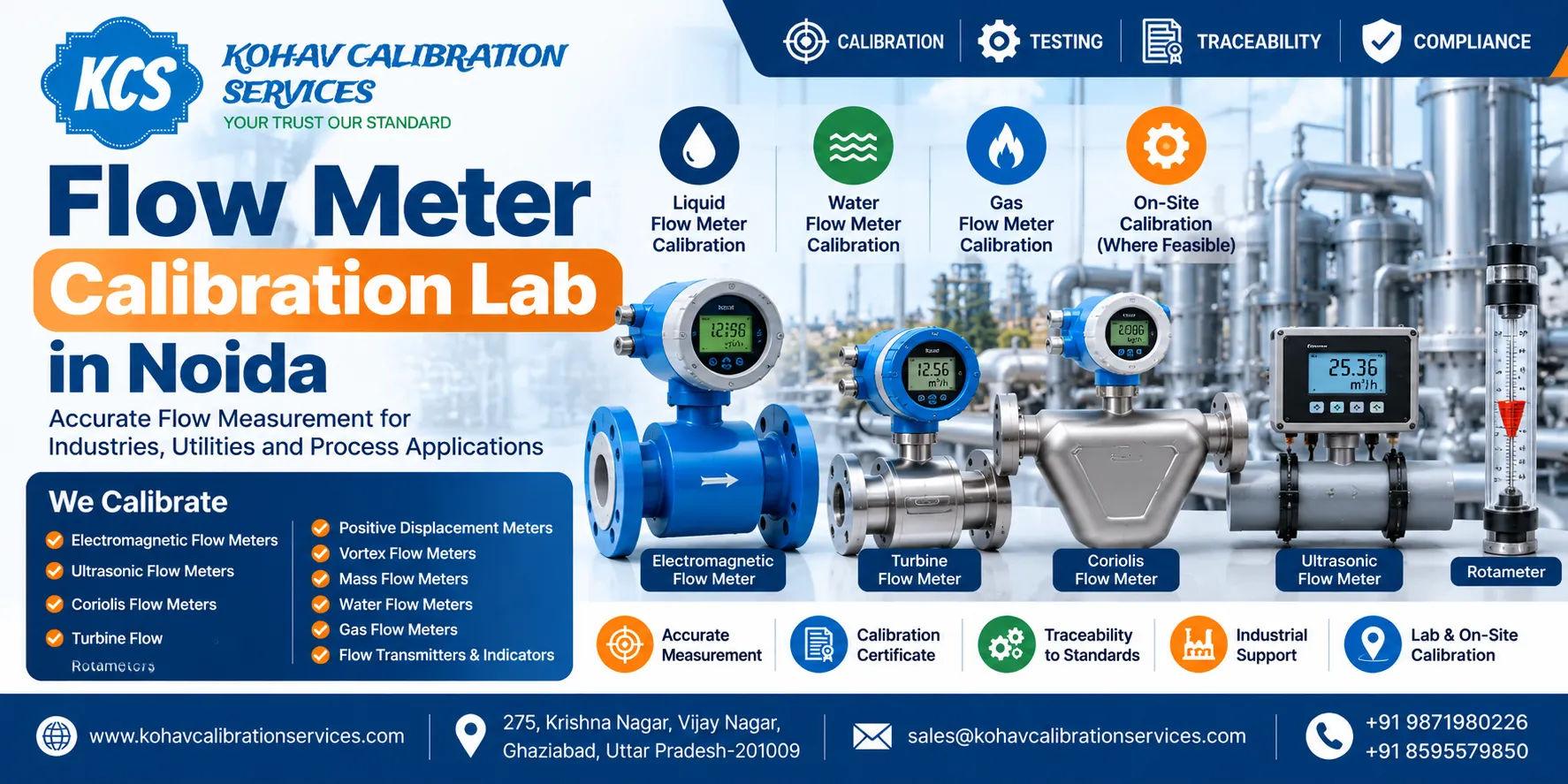
Kohav Calibration Services provides professional Flow Meter Calibration Lab in Noida services for industries that depend on accurate, repeatable and traceable flow measurement. Flow meters are used across manufacturing, pharmaceuticals, chemicals, water treatment, food processing, HVAC, utilities, laboratories, oil and gas and process industries where incorrect flow readings can affect product quality, process efficiency, energy consumption and operational safety.
Our flow calibration services are designed for a wide range of liquid, water, gas and industrial flow measurement instruments. Depending on the instrument type, operating conditions and required measurement range, calibration may be performed in a suitable laboratory environment or through an on-site service arrangement.
What Is Flow Meter Calibration?
Flow meter calibration is the process of comparing the indication or output of a flow measuring instrument against an appropriate reference standard under defined conditions.
The purpose is to determine whether the flow meter is measuring within the required accuracy limits and to identify any deviation between the instrument reading and the reference value.
A calibration process may involve:
- Identification and inspection of the flow meter
- Verification of instrument specifications
- Selection of suitable reference standards
- Controlled flow generation
- Measurement at selected test points
- Recording of readings
- Calculation of errors and deviations
- Assessment of measurement uncertainty where applicable
- Preparation of calibration documentation
- Identification of adjustment requirements where applicable
Calibration is different from routine maintenance. A meter may operate normally while still producing an inaccurate reading, which is why periodic calibration is important for measurement assurance.
Flow Meter Calibration Services in Noida
Kohav Calibration Services supports flow measurement requirements for manufacturing plants, laboratories, pharmaceutical facilities, chemical industries, food-processing units, utilities and other organizations in Noida.
Depending on technical capability and applicable scope, flow calibration requirements may include:
- Liquid flow meters
- Water flow meters
- Electromagnetic flow meters
- Ultrasonic flow meters
- Coriolis flow meters
- Turbine flow meters
- Vortex flow meters
- Rotameters
- Variable-area flow meters
- Mass flow meters
- Gas flow meters
- Air flow meters
- Flow transmitters
- Flow switches
- Flow indicators
- Flow controllers
- Industrial flow measurement assemblies
The exact calibration method, range, medium, uncertainty and acceptance criteria depend on the instrument and its intended application.
Liquid Flow Meter Calibration
Liquid flow meters are widely used in water treatment, chemical processing, pharmaceutical manufacturing, food production and industrial utilities.
Calibration may be required for instruments measuring:
- Water
- Process liquids
- Chemical solutions
- Industrial fluids
- Fuel and compatible liquids
- Other specified liquid media
The calibration arrangement should consider the meter’s size, flow range, connection configuration, fluid characteristics and manufacturer’s requirements.
Water Flow Meter Calibration
Water flow meters are commonly installed in:
- Water treatment plants
- RO plants
- ETP and STP systems
- Utility pipelines
- Manufacturing plants
- Cooling-water systems
- Building services
- Industrial water distribution
- Process-water systems
Calibration helps organizations determine whether the indicated water flow corresponds appropriately with the reference measurement.
Electromagnetic Flow Meter Calibration
Electromagnetic flow meters are commonly used for conductive liquids in industrial process applications.
Calibration requirements can include verification of:
- Flow indication
- Transmitter output
- Selected flow points
- Zero condition where applicable
- Instrument configuration
- Output signal
- Line-size-related installation considerations
For accurate results, the calibration arrangement should reflect the technical characteristics of the particular meter.
Ultrasonic Flow Meter Calibration
Ultrasonic flow meters are used for water, process liquids and other applications where non-invasive or inline flow measurement is required.
Calibration considerations may include:
- Flow range
- Meter technology
- Pipe configuration
- Sensor arrangement
- Output signal
- Installation conditions
- Reference measurement method
For clamp-on ultrasonic systems, actual installation conditions can have a significant influence on measurement performance.
Coriolis Flow Meter Calibration
Coriolis flow meters can provide mass-flow measurement and may also provide density-related measurements depending on the instrument configuration.
Calibration requirements can involve:
- Mass flow
- Volumetric flow
- Density-related parameters where applicable
- Transmitter output
- Selected test points
The appropriate calibration method depends on the meter design, fluid and required measurement range.
Turbine Flow Meter Calibration
Turbine flow meters are used in applications where accurate volumetric flow measurement is required.
Calibration may include testing across selected flow points to determine:
- Indicated flow
- Reference flow
- Percentage error
- Repeatability where applicable
- Output or pulse response
Regular calibration can help identify changes caused by wear, installation conditions or operating history.
Rotameter Calibration
Rotameters and variable-area flow meters are frequently used for local flow indication in laboratories, utilities and industrial systems.
Kohav Calibration Services can support calibration requirements for suitable rotameters subject to instrument range, medium and applicable technical capability.
The calibration record can provide measured readings and corresponding reference values for the selected test points.
Gas Flow Meter Calibration
Gas flow meters are used in manufacturing, laboratories, HVAC, gas distribution, pharmaceutical and process applications.
Depending on the instrument and applicable technical scope, calibration may cover:
- Air flow meters
- Gas flow meters
- Thermal mass flow meters
- Gas rotameters
- Turbine gas meters
- Rotary positive displacement meters
- Other applicable gas-flow instruments
Gas calibration requires careful consideration of the gas medium, pressure, temperature, flow range and reference standard.
Published calibration scopes for laboratories in Noida demonstrate that fluid-flow calibration can cover instruments such as gas meters, turbine meters and other flow-measuring devices, with defined measurement ranges and capabilities.
Flow Transmitter Calibration
A flow transmitter converts measurement information into an output signal used by control systems, PLCs, DCS systems or monitoring equipment.
Calibration may involve checking:
- Input or simulated measurement
- Display indication
- Output signal
- Zero and span
- Selected measurement points
- Transmitter response
Where a complete flow-metering system is involved, the calibration approach should be selected according to the measurement architecture and applicable technical requirements.
Flow Switch Calibration
Flow switches are used to detect whether flow is above, below or at a defined switching point.
Calibration or functional verification may be relevant for:
- Pump protection
- Cooling systems
- Process interlocks
- Water systems
- HVAC systems
- Industrial safety systems
The switching point and applicable acceptance criteria should be clearly specified before calibration.
Flow Meter Calibration Process
A typical flow meter calibration process at Kohav Calibration Services may include:
1. Instrument Identification
The flow meter is identified using available information such as:
- Manufacturer
- Model
- Serial number
- Range
- Size
- Measurement medium
- Output type
2. Technical Review
The required calibration points, accuracy requirements, application and operating conditions are reviewed.
3. Reference Standard Selection
A suitable reference system is selected according to the flow technology, measurement range and application.
4. Controlled Measurement
The flow meter is tested at defined points under controlled conditions.
5. Data Recording
Reference values and instrument indications are recorded systematically.
6. Error Evaluation
The observed difference between the reference and instrument indication is evaluated.
7. Uncertainty Assessment
Where applicable, measurement uncertainty is considered as part of the calibration evaluation.
8. Certificate Preparation
The calibration results are documented in a calibration certificate or report containing applicable instrument and measurement information.
Flow Meter Calibration Certificate
A flow meter calibration certificate should provide enough information to demonstrate what was calibrated and under what conditions.
Depending on the service, documentation may include:
- Customer details
- Instrument identification
- Manufacturer and model
- Serial number
- Calibration date
- Calibration location
- Reference standards
- Measurement points
- Reference readings
- Instrument readings
- Error or deviation
- Measurement uncertainty where applicable
- Environmental or operating conditions where relevant
- Calibration method or procedure
- Result status or observations
- Due date or recommended interval where specified
Customers should review the certificate to ensure that the instrument range and calibration parameters match their quality-system requirements.
Measurement Traceability
Traceability is an important part of reliable calibration.
A traceable calibration chain connects measurement results to recognized standards through documented comparisons and stated measurement uncertainties.
For regulated or quality-sensitive applications, customers should verify:
- Calibration laboratory competence
- Applicable accreditation status
- Exact accreditation scope
- Instrument type covered
- Measurement range
- Calibration medium
- Calibration method
- Measurement uncertainty
An accreditation certificate alone should not be assumed to cover every type or range of flow meter. The exact scope should always be checked.
On-Site Flow Meter Calibration in Noida
For large, permanently installed or difficult-to-remove flow meters, on-site calibration may be considered where technically suitable.
On-site service can be useful for flow meters installed in:
- Manufacturing plants
- Water-treatment facilities
- Chemical plants
- Pharmaceutical facilities
- Utility systems
- HVAC installations
- Process pipelines
- Industrial production lines
Before arranging an on-site calibration, technical details such as meter size, flow range, installation arrangement, accessibility, process medium, isolation possibilities and required reference equipment should be reviewed.
Flow Meter Calibration for Pharmaceutical Industries
Pharmaceutical manufacturing requires controlled measurement systems for utilities and process operations.
Flow meters may be associated with:
- Purified water systems
- Water-for-process applications
- Utility systems
- HVAC systems
- Process lines
- Cleaning systems
- Gas distribution
Calibration records can form part of the organization’s equipment-control and quality documentation.
Flow Meter Calibration for Food and Beverage Industries
Food and beverage facilities use flow measurement for:
- Water
- Ingredients
- Process liquids
- Cleaning systems
- Utilities
- CIP systems
Regular calibration can support process consistency and measurement control.
Flow Meter Calibration for Chemical Industries
Chemical plants often depend on flow measurement for dosing, transfer, mixing, utilities and process control.
Calibration requirements may involve challenging operating conditions, making correct instrument identification, suitable reference standards and defined test conditions particularly important.
Flow Meter Calibration for Water Treatment Plants
Water-treatment facilities use flow meters throughout:
- Raw-water systems
- RO systems
- Filtration systems
- ETP
- STP
- Chemical dosing
- Treated-water distribution
- Utility systems
Accurate flow measurement helps operators monitor process performance and maintain consistent operating conditions.
Flow Meter Calibration for Manufacturing Industries
Manufacturing plants may use flow meters for:
- Cooling water
- Compressed air
- Process liquids
- Gas supply
- Chemical dosing
- Utility monitoring
- Production processes
Kohav Calibration Services can support calibration planning for suitable flow instruments used across industrial operations in Noida.
Flow Meter Calibration in Noida Industrial Areas
Kohav Calibration Services can support calibration requirements for organizations located across Noida’s major industrial and commercial zones, subject to service feasibility.
Service areas may include:
- Sector 1
- Sector 2
- Sector 3
- Sector 5
- Sector 6
- Sector 7
- Sector 8
- Sector 9
- Sector 10
- Sector 11
- Sector 16
- Sector 18
- Sector 22
- Sector 37
- Sector 57
- Sector 58
- Sector 59
- Sector 60
- Sector 62
- Sector 63
- Sector 64
- Sector 65
- Sector 67
- Sector 80
- Sector 81
- Sector 83
- Sector 85
- Sector 88
- Sector 90
- Sector 128
- Sector 137
- Greater Noida and nearby industrial areas
Noida has an established calibration and instrumentation ecosystem, with laboratories operating across sectors such as Sector 9, Sector 63, Sector 64, Sector 65 and Sector 80.
How Often Should a Flow Meter Be Calibrated?
There is no single calibration interval suitable for every flow meter.
The appropriate interval can depend on:
- Manufacturer recommendations
- Instrument stability
- Measurement criticality
- Operating environment
- Process conditions
- Previous calibration results
- Regulatory requirements
- Customer quality-system procedures
- Frequency of use
- History of adjustment or repair
Many organizations establish calibration schedules based on risk and historical performance rather than applying the same interval to every instrument.
What Happens If a Flow Meter Fails Calibration?
If a flow meter does not meet the required acceptance criteria, the organization should evaluate the impact of the observed deviation.
Depending on the application, actions may include:
- Adjustment where appropriate
- Repair
- Recalibration
- Replacement
- Review of previous measurement results
- Evaluation of potentially affected batches or processes
- Documentation of corrective action
For critical applications, an out-of-tolerance result should be handled according to the organization’s quality procedure.
Calibration vs Verification vs Adjustment
These terms should not be treated as interchangeable.
Calibration compares an instrument against a reference standard and documents the measurement relationship.
Verification determines whether the instrument meets specified requirements or acceptance criteria.
Adjustment changes the instrument so that its indication or performance is brought closer to the required value.
An instrument may be calibrated without being adjusted. If adjustment is performed, a subsequent calibration may be required to document the resulting performance.
Why Choose Kohav Calibration Services?
Organizations looking for a Flow Meter Calibration Lab in Noida should consider more than location alone.
Kohav Calibration Services focuses on:
- Instrument-specific calibration planning
- Clear calibration documentation
- Traceable measurement practices where applicable
- Laboratory and on-site service options subject to technical feasibility
- Support for industrial and laboratory instruments
- Practical scheduling for production environments
- Identification of measurement requirements before service
- Calibration documentation suitable for quality-system records
- Technical communication throughout the service process
For accreditation-related requirements, customers should verify the current accreditation status and exact applicable scope for the required flow instrument, range, medium and calibration method.
Information Required for Flow Meter Calibration
For a quotation or technical review, customers should provide as much of the following information as possible:
- Instrument name
- Manufacturer
- Model number
- Serial number
- Flow range
- Meter size
- Measurement medium
- Liquid or gas application
- Accuracy requirement
- Output type
- Installation arrangement
- Calibration points
- On-site or laboratory requirement
- Calibration certificate requirements
- Required completion date
Providing these details helps determine the appropriate calibration approach before the instrument is submitted for service.
Frequently Asked Questions
What is a flow meter calibration lab?
A flow meter calibration lab is a facility where flow measuring instruments are compared against suitable reference standards under controlled conditions to determine measurement performance.
Do you provide flow meter calibration in Noida?
Kohav Calibration Services provides flow meter calibration support for suitable instruments and applications in Noida, subject to technical capability, measurement range and calibration requirements.
Which flow meters can be calibrated?
Depending on technical scope and application, calibration may cover electromagnetic, ultrasonic, turbine, Coriolis, rotameter, variable-area, mass, gas, liquid and other flow-measuring instruments.
Can flow meters be calibrated on site?
Yes, on-site calibration may be possible for suitable permanently installed flow meters, subject to technical feasibility, installation conditions and availability of appropriate reference equipment.
Do you calibrate water flow meters?
Water flow meter calibration can be supported for suitable instruments, subject to the required flow range, meter type, installation arrangement and applicable technical capability.
Do you calibrate gas flow meters?
Gas flow meter calibration may be available for suitable gas-flow instruments. The gas type, pressure, flow range and measurement technology should be provided before service.
How often should a flow meter be calibrated?
The calibration interval depends on the instrument, application, historical stability, operating conditions, manufacturer recommendations and quality-system requirements.
What information is needed for a flow meter calibration quotation?
The most useful information includes manufacturer, model, serial number, meter size, flow range, measurement medium, required accuracy, calibration points and whether laboratory or on-site calibration is required.
Is calibration the same as flow meter maintenance?
No. Calibration evaluates measurement performance against a reference. Maintenance involves inspection, servicing, cleaning, repair or replacement of components.
How can I select a flow meter calibration laboratory in Noida?
Consider the laboratory’s technical capability, applicable measurement range, calibration medium, method, uncertainty, traceability, documentation and current accreditation scope where accreditation is required.
Get Flow Meter Calibration Support in Noida
Accurate flow measurement is important for process control, quality assurance, utility monitoring and reliable industrial operations. Kohav Calibration Services provides flow meter calibration support for organizations in Noida requiring documented and technically appropriate measurement verification.
For a calibration requirement, share the flow meter type, manufacturer, model, range, size, measurement medium and location with Kohav Calibration Services so the appropriate calibration method and service arrangement can be evaluated.