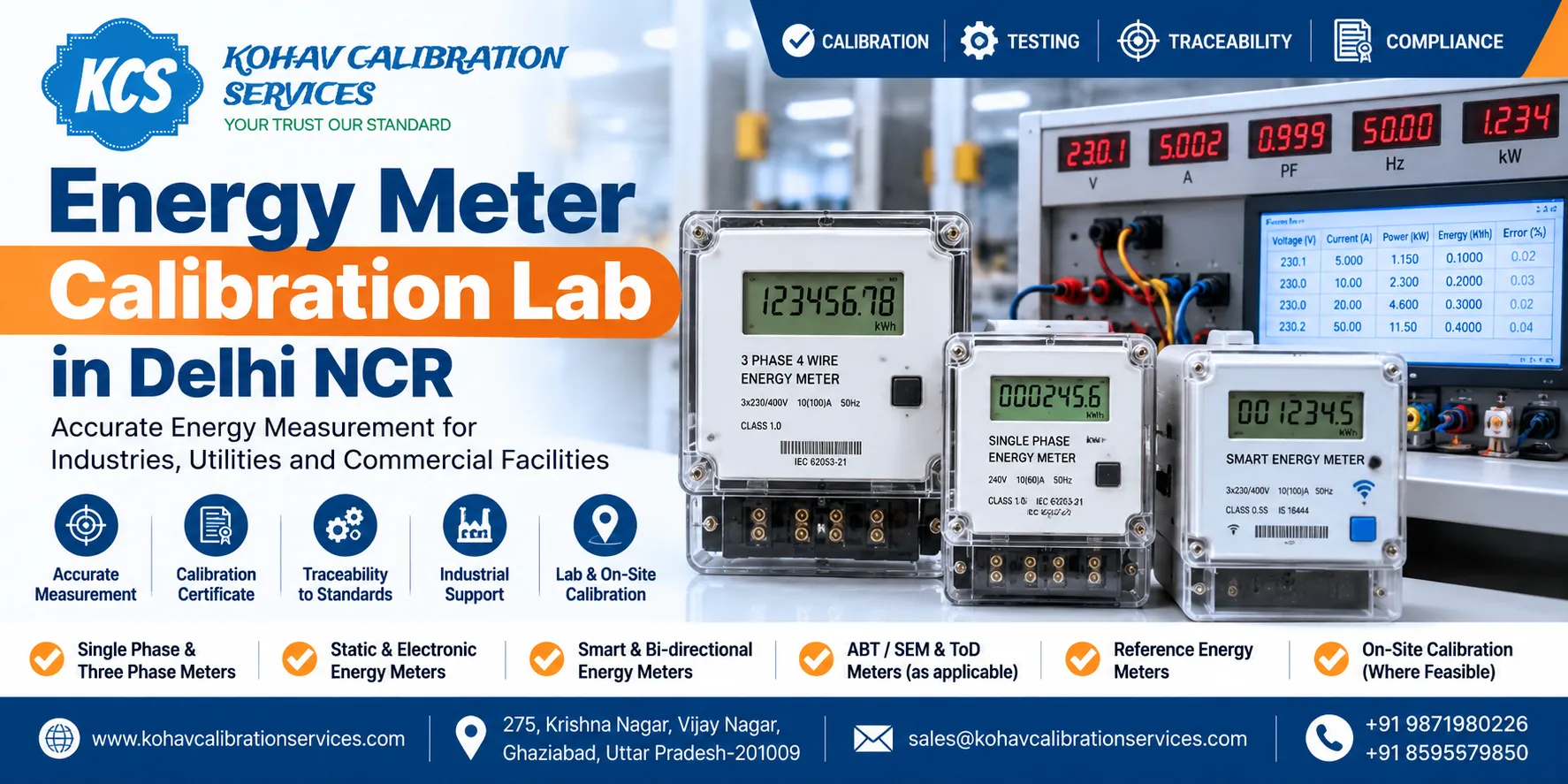
Kohav Calibration Services provides professional Energy Meter Calibration Lab in Delhi NCR services for organizations that require accurate, reliable and documented electrical energy measurement.
Energy meters are critical measurement instruments used in industrial plants, commercial buildings, electrical distribution systems, utilities, laboratories, manufacturing facilities, solar installations and energy-management applications. An inaccurate energy meter can affect billing, energy accounting, process monitoring, power-quality analysis and internal energy-management decisions.
Kohav Calibration Services supports calibration requirements for suitable energy meters and associated electrical measurement equipment, subject to the instrument type, measurement range, applicable method and technical capability.
What Is Energy Meter Calibration?
Energy meter calibration is the process of comparing the measurement performance of an energy meter with an appropriate reference standard under defined electrical conditions.
The objective is to determine the measurement error of the meter at selected test points and establish whether its performance meets the specified acceptance criteria.
Energy meter calibration may involve evaluation of:
- Voltage
- Current
- Active power
- Reactive power
- Apparent power
- Power factor
- Frequency
- Energy measurement
- Phase relationship
- Meter error
- Starting condition
- No-load condition
- Registration accuracy
- Pulse output, where applicable
The exact parameters depend on the meter design, class, application and applicable calibration or testing procedure.
Energy Meter Calibration Services in Delhi NCR
Kohav Calibration Services provides calibration support for suitable electrical energy measurement instruments used across Delhi NCR.
Depending on the instrument and applicable technical scope, services may include:
- Single-phase energy meter calibration
- Three-phase energy meter calibration
- Static energy meter calibration
- Electronic energy meter calibration
- Digital energy meter calibration
- Bi-directional energy meter testing
- Smart meter testing and calibration support
- Import/export energy measurement verification
- Reference energy meter calibration
- Power and energy analyzer calibration
- Energy measurement system verification
- Meter testing at selected electrical load points
- On-site energy meter calibration where technically feasible
The exact calibration range and applicable standards should be confirmed against the laboratory’s current technical capability and scope before service.
Single-Phase Energy Meter Calibration
Single-phase energy meters are commonly used in residential, commercial and smaller industrial electrical installations.
Calibration can involve comparison of the meter’s energy registration against a suitable reference system under defined:
- Voltage
- Current
- Frequency
- Power factor
- Load conditions
Testing at multiple points can help identify measurement deviations across the meter’s operating range.
Three-Phase Energy Meter Calibration
Three-phase energy meters are extensively used in industrial and commercial applications.
They may be installed for:
- Factory electrical distribution
- Commercial buildings
- Industrial feeders
- Production machinery
- Utility monitoring
- Electrical panels
- Energy-management systems
Three-phase meter testing may require controlled phase voltage, current, frequency, phase sequence and power-factor conditions.
Where required, individual phase behavior and overall energy registration may be evaluated according to the applicable procedure.
Static Energy Meter Calibration
Static or electronic energy meters are widely used in modern electrical distribution systems.
Depending on the meter type, calibration or testing may address:
- Active energy
- Reactive energy
- Apparent energy
- Voltage
- Current
- Frequency
- Power factor
- Meter accuracy
- Starting condition
- No-load condition
- Pulse output
Published government laboratory scopes in the Delhi region demonstrate testing of static energy meters at specified accuracy classes and electrical conditions.
Smart Energy Meter Testing and Calibration
Smart meters incorporate electronic measurement, communication and data-management functions.
Depending on the applicable requirement, testing may include evaluation of:
- Energy measurement accuracy
- Voltage and current measurement
- Communication-related functionality
- Meter registration
- Tamper-related functions
- Bidirectional measurement
- Load conditions
- Display and data parameters
Delhi electricity-regulatory documentation specifically identifies smart meters as a category for which testing and calibration laboratories may need defined technical capability.
Bi-Directional Energy Meter Calibration
Bi-directional meters measure energy flowing in more than one direction and are commonly associated with applications such as:
- Solar power systems
- Grid-connected renewable energy
- Net-metering systems
- Captive power systems
- Industrial energy management
Calibration or testing may require evaluation of import and export energy registration under appropriate electrical conditions.
ABT and SEM Meter Testing
Specialized energy meters may be used for electricity-accounting and power-system applications.
ABT/SEM-related meters can involve more demanding measurement and documentation requirements than ordinary commercial meters.
For such applications, the customer should specify:
- Meter type
- Accuracy class
- Voltage range
- Current range
- CT/PT ratios
- Energy parameters
- Applicable standard
- Required test points
- Required reporting format
Delhi regulatory documentation specifically references ABT/SEM meters and applicable standards in the context of energy-meter testing laboratories.
ToD Energy Meter Testing
Time-of-Day meters record energy consumption according to defined time periods or tariff windows.
Testing requirements may involve:
- Energy registration
- Time-related functionality
- Tariff registers
- Import/export registers
- Display parameters
- Accuracy under defined electrical conditions
The exact testing requirements should be established from the customer’s meter specification and applicable utility or regulatory requirements.
Energy Meter Calibration for CT Operated Systems
Some industrial energy meters operate through current transformers and, in certain systems, voltage transformers.
For these applications, calibration planning may need to consider:
- CT ratio
- PT/VT ratio
- Meter input configuration
- Accuracy class
- Secondary current
- Secondary voltage
- Phase relationship
- Wiring configuration
Where instrument transformers are part of the measurement chain, the customer should clarify whether only the meter or the complete metering system is required to be evaluated.
Energy Meter Calibration with Power and Energy Analyzers
Power and energy analyzers are used to measure electrical parameters and can themselves require periodic calibration.
Kohav Calibration Services can support suitable electrical measurement requirements involving:
- Power meters
- Energy analyzers
- Digital power meters
- Multifunction meters
- Electrical panel meters
- Reference energy standards
- Portable electrical measuring systems
The applicable parameters and measurement range depend on the specific instrument.
Government and technical laboratories in India list reference energy standards, energy meters and digital power analyzers among electro-technical calibration services.
Energy Meter Calibration Process
A typical calibration process may include the following steps.
1. Instrument Identification
The meter is identified using:
- Manufacturer
- Model
- Serial number
- Meter type
- Accuracy class
- Voltage rating
- Current rating
- Frequency
- Meter configuration
2. Technical Review
The required measurement parameters, test points, applicable specifications and acceptance criteria are reviewed.
3. Reference Standard Selection
A suitable reference energy standard or electrical measurement system is selected according to the required measurement range and application.
4. Electrical Test Setup
The meter is connected to the appropriate test arrangement under controlled electrical conditions.
5. Measurement at Defined Points
The meter is evaluated at selected combinations of voltage, current, frequency and power factor as applicable.
6. Error Calculation
The difference between the reference measurement and meter indication or registration is calculated.
7. Repeatability and Additional Checks
Where applicable, repeat measurements or additional functional checks may be performed.
8. Results Evaluation
The measured results are compared with the applicable specification or customer acceptance criteria.
9. Calibration Documentation
The measured results are documented in a calibration certificate or test report.
Energy Meter Calibration Certificate
A calibration certificate should clearly identify the instrument and the conditions under which it was evaluated.
Depending on the service, documentation may include:
- Customer name
- Instrument identification
- Manufacturer
- Model
- Serial number
- Accuracy class
- Voltage range
- Current range
- Frequency
- Power factor
- Test points
- Reference readings
- Meter readings
- Percentage error
- Measurement uncertainty where applicable
- Reference standards
- Calibration method
- Calibration date
- Calibration location
- Environmental conditions where relevant
- Result or conformity statement where applicable
For regulated applications, the certificate format and required information should be agreed before testing.
Measurement Traceability for Energy Meters
Measurement traceability is important when energy measurements are used for quality, regulatory, commercial or process-control purposes.
A reliable calibration chain connects the measurement result to recognized standards through documented comparisons and stated measurement uncertainty where applicable.
Customers should review:
- Reference standard identification
- Calibration status of reference equipment
- Measurement uncertainty
- Applicable calibration method
- Measurement range
- Electrical parameters covered
- Laboratory competence
- Applicable accreditation scope
An accreditation claim should always be checked against the current certificate and exact technical scope rather than assumed to apply to every energy-meter type or measurement range.
NABL Scope for Energy Meter Calibration
For organizations specifically requiring NABL-accredited calibration or testing, the exact accreditation scope is important.
Delhi Electricity Regulatory Commission documentation for third-party meter testing laboratories specifically asks for evidence of NABL accreditation under ISO/IEC 17025 and identifies categories such as:
- Electro-mechanical meters
- Static meters
- Bi-directional meters
- Smart meters
- ABT/SEM meters
- ToD meters
It also asks laboratories to specify whether on-site testing and calibration facilities are available.
Therefore, customers should verify the current NABL certificate, laboratory scope, meter category, accuracy class, measurement range and applicable test method before selecting a laboratory for a regulated requirement.
On-Site Energy Meter Calibration in Delhi NCR
Some energy meters are installed inside electrical panels, substations, industrial distribution systems or other locations where removal can be inconvenient or disruptive.
Where technically feasible, on-site testing or calibration can reduce equipment downtime.
On-site requirements may apply to:
- Industrial energy meters
- Panel-mounted meters
- Feeder meters
- Commercial electrical meters
- HT/LT metering systems
- Solar energy meters
- Import/export meters
- Energy monitoring systems
- Fixed electrical measurement equipment
The feasibility of on-site calibration depends on the meter type, electrical installation, access, safety requirements, available test conditions and suitable reference equipment.
Energy Meter Calibration for Manufacturing Industries
Manufacturing plants rely on energy meters for:
- Production-line energy monitoring
- Machine-level energy measurement
- Utility monitoring
- Electrical distribution
- Energy audits
- Internal cost allocation
- Energy-efficiency programs
Periodic calibration can help organizations maintain confidence in the measurements used for operational and energy-management decisions.
Energy Meter Calibration for Pharmaceutical Industries
Pharmaceutical facilities use electrical measurement systems across manufacturing, HVAC, utilities, laboratories and support infrastructure.
Energy meters may be integrated into:
- Electrical panels
- HVAC systems
- Utility systems
- Production areas
- Chiller plants
- Boiler utilities
- Facility-management systems
Calibration records can support equipment-control and quality-system documentation where electrical measurement is part of a controlled process.
Energy Meter Calibration for Commercial Buildings
Commercial facilities may use energy meters for:
- Tenant energy allocation
- Building energy monitoring
- HVAC consumption
- Common-area consumption
- Generator monitoring
- Solar generation
- Electrical distribution
Calibration can help organizations verify that energy-monitoring instruments are performing within their specified requirements.
Energy Meter Calibration for Solar and Renewable Energy Systems
Solar installations increasingly use energy meters for measuring:
- Solar generation
- Grid import
- Grid export
- Net energy
- Inverter output
- Plant auxiliary consumption
Bi-directional energy measurement is particularly relevant to grid-connected renewable-energy systems.
The appropriate calibration or testing requirements depend on the meter specification, utility requirements and applicable standards.
Energy Meter Calibration for Electrical Contractors and EPC Companies
Electrical contractors and EPC companies may require calibrated meters during:
- Commissioning
- Acceptance testing
- Electrical installation
- Energy audits
- Project handover
- Performance verification
- Maintenance activities
Calibration documentation can help demonstrate that measurement instruments used during project activities were appropriately controlled.
Energy Meter Calibration in Delhi NCR Industrial Areas
Kohav Calibration Services can support suitable energy-meter calibration requirements across Delhi NCR, subject to technical feasibility and service arrangements.
Potential service locations include:
- Delhi
- New Delhi
- Noida
- Greater Noida
- Ghaziabad
- Sahibabad
- Faridabad
- Gurugram
- Manesar
- Bahadurgarh
- Bawana
- Okhla
- Patparganj
- Mayapuri
- Naraina
- Wazirpur
- Anand Parbat
- Narela
- Jhilmil Industrial Area
- Mohan Nagar
- Sahibabad Industrial Area
- Noida Sector 10
- Noida Sector 57
- Noida Sector 58
- Noida Sector 63
- Noida Sector 64
- Noida Sector 65
- Greater Noida industrial areas
Delhi NCR has an established ecosystem for electrical calibration and energy-meter testing. For example, CPRI operates an Energy Meter Testing Laboratory in Noida for static and smart meter testing, while other Delhi NCR laboratories publish electro-technical calibration capabilities covering energy meters and related electrical instruments.
How Often Should an Energy Meter Be Calibrated?
The appropriate calibration interval depends on:
- Meter accuracy class
- Application criticality
- Manufacturer recommendations
- Regulatory requirements
- Previous calibration results
- Operating environment
- Electrical loading conditions
- Measurement stability
- Customer quality procedures
- Frequency of use
- Consequences of inaccurate measurement
Critical energy meters may require more controlled calibration schedules than instruments used only for general monitoring.
Organizations should establish intervals based on their documented quality and measurement-management procedures.
What Happens If an Energy Meter Fails Calibration?
If an energy meter is found outside the required acceptance limits, the organization should assess the significance of the deviation.
Depending on the application, corrective actions may include:
- Adjustment where supported
- Repair
- Recalibration
- Replacement
- Review of historical measurements
- Assessment of affected energy records
- Review of billing or internal allocation data
- Corrective action documentation
For commercially or regulatorily significant meters, the response should follow the applicable utility, regulatory or quality-system procedure.
Calibration vs Verification vs Testing
These terms are related but should not automatically be treated as identical.
Calibration establishes the relationship between the instrument indication and a reference measurement under specified conditions.
Verification determines whether the instrument satisfies defined requirements or acceptance criteria.
Testing may involve a broader set of performance or functional checks specified by a standard, customer, utility or regulatory authority.
An energy meter can therefore be subjected to several different types of evaluation depending on its intended use.
Why Choose Kohav Calibration Services?
Organizations searching for an Energy Meter Calibration Lab in Delhi NCR should consider the technical requirements of their specific meter rather than selecting a laboratory based only on location.
Kohav Calibration Services focuses on:
- Instrument-specific calibration planning
- Electrical measurement requirements
- Clear calibration documentation
- Traceability considerations
- Laboratory and on-site service options where technically feasible
- Support for industrial electrical instruments
- Practical coordination with customer schedules
- Defined calibration points and measurement parameters
- Quality-focused reporting
- Technical review before calibration
Where accreditation is required, customers should verify the current accreditation certificate and exact scope applicable to their particular energy meter and measurement requirements.
Information Required for Energy Meter Calibration
For a quotation or technical review, customers should provide:
- Meter manufacturer
- Model number
- Serial number
- Single-phase or three-phase configuration
- Accuracy class
- Voltage rating
- Current rating
- Frequency
- CT/PT ratio where applicable
- Direct or CT-operated connection
- Active/reactive/apparent energy requirement
- Power-factor range
- Meter type
- Required standard or specification
- Required test points
- Laboratory or on-site requirement
- Certificate requirements
- Quantity of meters
- Required completion date
Providing complete technical information helps determine the appropriate calibration arrangement.
Frequently Asked Questions
What is an energy meter calibration lab?
An energy meter calibration laboratory evaluates energy meters against suitable reference standards under defined electrical conditions and documents the resulting measurement performance.
Do you provide energy meter calibration in Delhi NCR?
Kohav Calibration Services provides calibration support for suitable energy meters and related electrical measurement instruments across Delhi NCR, subject to technical capability, measurement range and service requirements.
Do you calibrate single-phase energy meters?
Suitable single-phase energy meters can be considered for calibration based on their specifications, measurement range and applicable technical requirements.
Do you calibrate three-phase energy meters?
Yes, suitable three-phase energy meters can be evaluated for calibration or testing according to their configuration, electrical range and applicable requirements.
Can smart meters be tested?
Smart meters require instrument-specific testing and calibration requirements. The exact meter model, functions, accuracy class and applicable standard should be reviewed before service.
Can bi-directional energy meters be calibrated?
Bi-directional energy meters can require import and export energy measurement evaluation. The applicable test arrangement depends on the meter and customer requirements.
Is on-site energy meter calibration available?
On-site calibration or testing may be possible for suitable permanently installed meters, subject to technical feasibility, electrical safety, access and appropriate reference equipment.
What standards are used for energy meter testing?
The applicable standard depends on the meter type and intended application. Delhi regulatory documentation references standards including IS 15707, IS 16444 and IS 14697 for different energy-meter categories.
How often should an energy meter be calibrated?
The interval should be established according to the meter’s application, accuracy requirements, historical performance, manufacturer recommendations, regulatory requirements and organizational quality procedures.
What information is required for an energy meter calibration quotation?
Manufacturer, model, serial number, meter type, accuracy class, voltage/current ratings, CT/PT ratios where applicable, required test points and on-site or laboratory requirements are useful for preparing a technical quotation.
Is an energy meter calibration certificate the same as an inspection report?
Not necessarily. A calibration certificate documents measurement results against reference standards, while an inspection or test report may address broader requirements depending on the applicable procedure.
Get Energy Meter Calibration Support in Delhi NCR
Reliable energy measurement supports electrical monitoring, energy accounting, process control and operational decision-making. Kohav Calibration Services provides Energy Meter Calibration Lab in Delhi NCR support for suitable energy meters and electrical measurement instruments, with laboratory and on-site options considered according to technical requirements.
To discuss an energy-meter calibration requirement, provide the meter type, manufacturer, model, accuracy class, voltage/current rating, CT/PT details, required test parameters and location.