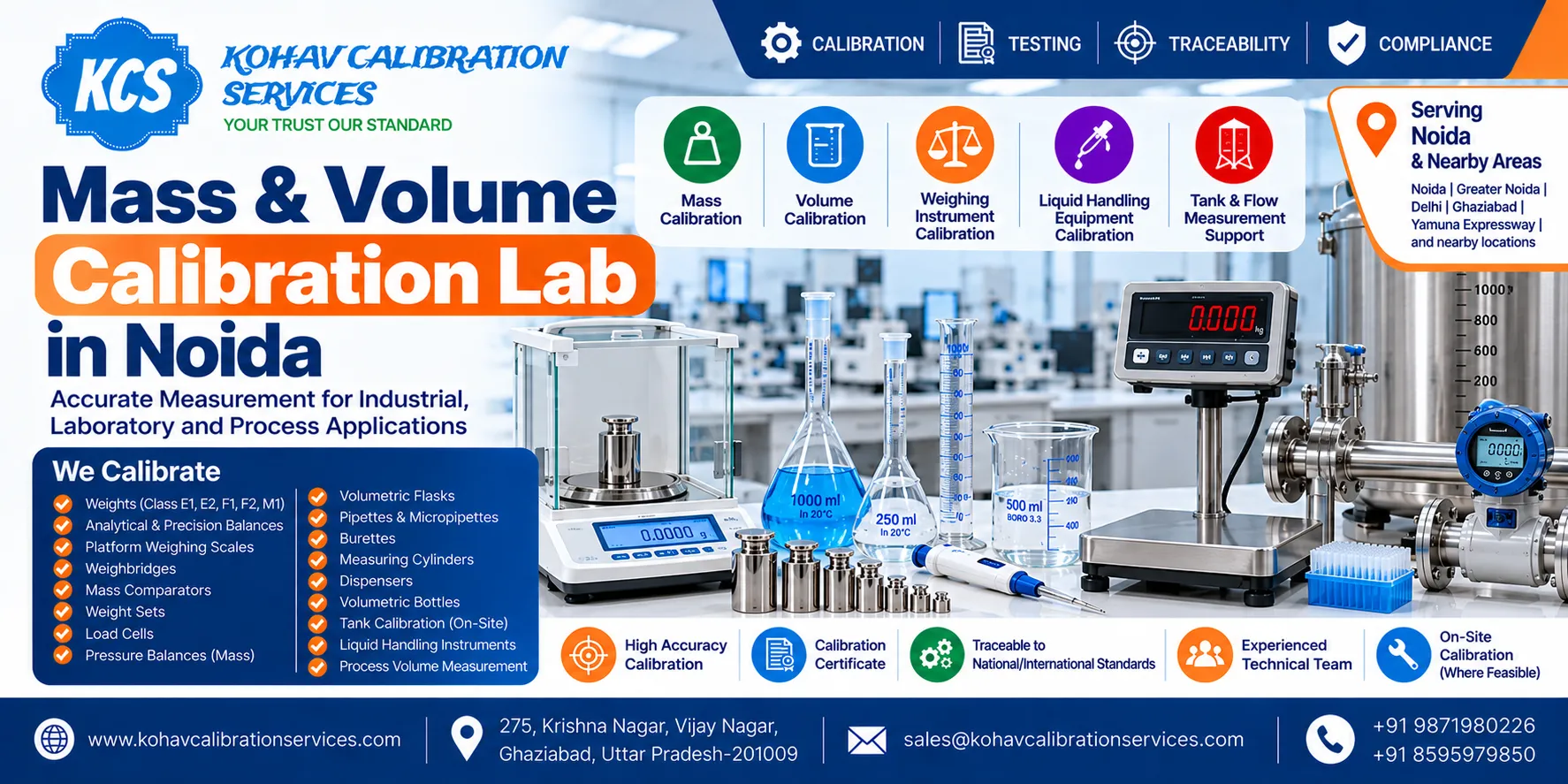
Kohav Calibration Services provides professional Mass & Volume Calibration Lab in Noida services for weighing instruments, standard weights, balances, pipettes, burettes, volumetric glassware and other equipment used for accurate mass and volume measurement.
Reliable mass and volume measurements are essential for manufacturing, pharmaceuticals, laboratories, food processing, chemicals, research, healthcare and quality-control operations. Regular calibration helps organizations identify measurement errors, maintain consistency and support documented quality requirements.
Kohav Calibration Services provides calibration support for customers across Noida and the surrounding Delhi NCR industrial region, with services planned according to the instrument type, measurement range, accuracy requirements and applicable calibration method.
What Is Mass and Volume Calibration?
Mass calibration verifies whether weighing equipment and mass standards provide measurements within their required accuracy and tolerance.
Volume calibration verifies the measurement capacity and accuracy of volumetric equipment used to dispense, contain or measure liquids.
Mass and volume calibration may involve reference standards, controlled environmental conditions, appropriate measurement procedures and evaluation of measurement uncertainty where applicable.
The objective is to establish documented evidence of instrument performance and provide reliable measurement results for quality-control and production activities.
Mass & Volume Calibration Services in Noida
Kohav Calibration Services supports calibration requirements for a wide range of mass and volume measuring equipment used by industries and laboratories in Noida.
Mass Calibration Services
Mass calibration can include:
- Standard weights
- Calibration weights
- E1, E2, F1, F2 and M-class weights, subject to applicable capability
- Weight sets and weight boxes
- Laboratory balances
- Analytical balances
- Precision balances
- Electronic balances
- Platform weighing systems
- Industrial weighing scales
- Bench scales
- Other weighing instruments
The applicable calibration range and accuracy depend on the instrument, reference standards and technical scope available for the required service.
Standard Weight Calibration in Noida
Standard weights are used as reference standards for checking and verifying weighing instruments. Their accuracy can directly affect the reliability of laboratory and industrial measurements.
Calibration of weights can involve evaluation of:
- Nominal mass
- Indication or comparison results
- Repeatability
- Measurement uncertainty
- Applicable tolerance or accuracy class
- Environmental conditions
- Reference standard traceability
Kohav Calibration Services can support organizations requiring documented calibration of weights according to the applicable technical requirements.
Weighing Balance Calibration
Weighing balances are widely used in laboratories, manufacturing facilities, pharmaceutical operations, chemical industries and quality-control departments.
Calibration may be required for:
- Analytical balances
- Precision balances
- Laboratory balances
- Electronic balances
- Top-pan balances
- Bench balances
- Industrial weighing balances
- Platform scales
The calibration approach depends on the balance capacity, readability, intended use and applicable procedure.
Analytical Balance Calibration in Noida
Analytical balances are commonly used where small differences in mass need to be measured accurately.
Calibration and verification may consider:
- Balance readability
- Repeatability
- Accuracy
- Linearity where applicable
- Reference weights
- Environmental influences
- Measurement uncertainty
- Operating conditions
Regular calibration can help laboratories maintain confidence in measurement results and identify changes in balance performance.
Industrial Scale Calibration in Noida
Industrial weighing systems are used in manufacturing, warehousing, packaging, chemical processing, food production and other applications.
Examples include:
- Platform weighing scales
- Floor scales
- Bench scales
- Heavy-capacity weighing systems
- Industrial electronic scales
- Process weighing equipment
For industrial applications, the appropriate calibration method depends on capacity, resolution, operating environment and intended measurement use.
Volume Calibration Services in Noida
Volume calibration applies to equipment used to measure, transfer or contain liquids.
Typical equipment includes:
- Micropipettes
- Pipettes
- Burettes
- Measuring cylinders
- Volumetric flasks
- Graduated cylinders
- Measuring jars
- Laboratory glassware
- Syringes
- Other volumetric measuring equipment
Publicly available calibration scopes from laboratories and government technical facilities include equipment such as micropipettes, pipettes, burettes, measuring cylinders and volumetric flasks.
Micropipette Calibration in Noida
Micropipettes are widely used in pharmaceutical, biotechnology, medical, research and laboratory environments.
Calibration helps evaluate whether a pipette delivers the intended volume consistently.
Important factors can include:
- Nominal volume
- Selected test volumes
- Repeatability
- Systematic error
- Environmental conditions
- Calibration method
- Measurement uncertainty
Pipette calibration should be performed according to the applicable technical procedure and the instrument’s intended operating range.
Pipette and Burette Calibration
Pipettes and burettes are used for accurate liquid transfer and measurement in laboratories, chemical facilities, educational institutions and quality-control environments.
Calibration can help establish whether the actual delivered or contained volume corresponds with the specified volume.
Kohav Calibration Services provides calibration support based on the equipment type, measurement range and applicable technical requirements.
Volumetric Flask Calibration
Volumetric flasks are designed for preparing solutions at specified volumes. Their dimensional and volumetric accuracy can therefore be important in laboratory testing and analytical work.
Calibration can provide documented evidence regarding the measured volume and applicable uncertainty.
Measuring Cylinder Calibration
Measuring cylinders are commonly used for approximate or controlled liquid-volume measurements in laboratories, production areas and testing facilities.
Calibration can help verify the relationship between the indicated volume and the actual measured volume.
Why Mass & Volume Calibration Is Important
Accurate measurement is an important part of quality management.
Regular calibration can help organizations:
- Detect measurement errors
- Maintain consistency in testing and production
- Improve confidence in measurement results
- Support quality-control procedures
- Reduce measurement-related process variation
- Maintain calibration records
- Support audits and customer requirements
- Identify instruments requiring adjustment or maintenance
- Improve measurement traceability where applicable
For laboratories and manufacturing organizations, documented calibration records can also provide useful evidence during internal and external quality reviews.
Mass & Volume Calibration Process at Kohav
A typical calibration workflow may include the following steps:
1. Instrument Identification
The instrument is identified using available information such as:
- Manufacturer
- Model
- Serial number
- Asset number
- Measurement range
- Resolution
- Location or department
2. Visual and Functional Inspection
The equipment is checked for visible damage, operating condition and suitability for calibration.
3. Selection of Reference Standards
Appropriate reference standards are selected according to the instrument’s range, accuracy and applicable procedure.
4. Environmental Stabilization
Where required, the instrument and reference standards are allowed to stabilize under appropriate environmental conditions.
5. Calibration Measurements
Measurements are taken according to the applicable calibration procedure.
6. Evaluation of Results
The observed results are evaluated against applicable specifications, tolerances or acceptance criteria.
7. Documentation
A calibration certificate or report is prepared with relevant measurement results and supporting information.
8. Identification of Calibration Status
The instrument may be identified with calibration status information according to the customer’s quality-system requirements.
Mass Calibration Certificate
A mass calibration certificate may contain information such as:
- Customer details
- Instrument identification
- Weight identification
- Nominal value
- Calibration date
- Calibration method
- Reference standards
- Measurement results
- Measurement uncertainty, where applicable
- Environmental conditions, where applicable
- Traceability information
- Calibration status
- Technician or authorized personnel details
The exact certificate content depends on the service and applicable technical requirements.
Volume Calibration Certificate
A volume calibration certificate may include:
- Equipment identification
- Manufacturer and model
- Nominal volume
- Test volume
- Measurement results
- Repeatability or relevant statistical information
- Measurement uncertainty
- Environmental conditions where applicable
- Reference standards
- Calibration date
- Traceability information
- Applicable method or procedure
Measurement Traceability for Mass and Volume Calibration
Measurement traceability is important when measurement results need to be related to recognized reference standards through a documented chain of calibrations.
The applicable traceability route depends on the reference standards, calibration method and service scope.
Kohav Calibration Services provides calibration documentation based on the applicable technical requirements and available calibration capability.
Where accreditation is required, customers should verify the laboratory’s current accreditation status and specific scope for the required parameter, range and instrument before placing an order.
Environmental Conditions During Calibration
Mass and volume measurements can be affected by environmental conditions.
Depending on the instrument and calibration method, relevant factors may include:
- Temperature
- Relative humidity
- Air movement
- Vibration
- Drafts
- Instrument stabilization
- Cleanliness
- Handling conditions
For sensitive weighing applications, environmental control can be particularly important because small changes may influence measurement results.
On-Site Mass & Volume Calibration in Noida
Some instruments may be difficult to remove from production facilities because of their size, capacity, installation or operational requirements.
Where technically feasible, on-site calibration can reduce equipment transportation and production disruption.
On-site calibration requirements may apply to:
- Industrial weighing systems
- Large platform scales
- Installed weighing equipment
- Production-related measurement equipment
- Equipment requiring calibration at its operating location
The feasibility of on-site calibration depends on the instrument, required reference standards, environmental conditions and technical procedure.
Industries Requiring Mass & Volume Calibration in Noida
Noida has a diverse industrial and commercial base, including manufacturing, electronics, pharmaceuticals, food processing, laboratories, engineering and technology-related businesses.
Mass and volume calibration can be relevant to:
- Pharmaceutical industries
- Biotechnology laboratories
- Chemical industries
- Food and beverage manufacturers
- Electronics manufacturers
- Engineering companies
- Research laboratories
- Medical laboratories
- Testing laboratories
- Manufacturing units
- Quality-control departments
- Packaging companies
- Educational and R&D institutions
Noida’s established industrial sectors, including areas such as Sector 10, Sector 16, Sector 57, Sector 58, Sector 59, Sector 60, Sector 63, Sector 64, Sector 65 and surrounding industrial areas, create demand for measurement and calibration support.
Mass & Volume Calibration Services Near Noida Industrial Areas
Kohav Calibration Services can support calibration requirements for organizations located in and around:
- Sector 10 Noida
- Sector 16 Noida
- Sector 57 Noida
- Sector 58 Noida
- Sector 59 Noida
- Sector 60 Noida
- Sector 63 Noida
- Sector 64 Noida
- Sector 65 Noida
- Sector 67 Noida
- Sector 80 Noida
- Sector 83 Noida
- Sector 85 Noida
- Sector 88 Noida
- Sector 90 Noida
- Sector 137 Noida
- Greater Noida
- Dadri
- Surajpur
- Greater Noida industrial areas
- Other Delhi NCR locations, subject to service feasibility
How Often Should Mass and Volume Equipment Be Calibrated?
There is no single calibration interval suitable for every instrument.
The interval can depend on:
- Instrument type
- Frequency of use
- Measurement accuracy requirements
- Operating environment
- Manufacturer recommendations
- Previous calibration history
- Risk associated with incorrect measurement
- Internal quality procedures
- Customer or regulatory requirements
Organizations should establish calibration intervals based on their quality-management system and actual equipment performance.
What Happens If a Balance or Measuring Instrument Fails Calibration?
When an instrument does not meet the applicable acceptance criteria, the organization should evaluate the impact of the result.
Depending on the situation, actions may include:
- Instrument adjustment
- Repair or maintenance
- Recalibration
- Reinspection
- Review of previous measurement results
- Identification of affected products or tests
- Updating the calibration status
The appropriate corrective action depends on the instrument and the organization’s quality procedures.
Calibration vs Adjustment
Calibration and adjustment are different activities.
Calibration determines the measurement performance of an instrument by comparing it with appropriate reference standards.
Adjustment changes the instrument so that its measurement performance can meet a specified requirement.
An instrument can be calibrated without adjustment. If adjustment is performed, the equipment may require calibration again to document its condition after adjustment.
Why Choose Kohav Calibration Services in Noida?
Kohav Calibration Services focuses on practical calibration support for industrial and laboratory measurement equipment.
Key service considerations include:
- Wide range of mass and volume equipment
- Professional calibration documentation
- Measurement-focused technical procedures
- Support for industrial and laboratory applications
- Calibration planning based on instrument requirements
- On-site service feasibility where applicable
- Delhi NCR service coverage
- Focus on measurement reliability and documentation
- Support for quality-control and audit requirements
Calibration capability, range and accreditation status should always be confirmed for the specific instrument and parameter before service.
Information Required for Calibration
For a faster quotation or service assessment, customers can provide:
- Instrument name
- Manufacturer
- Model number
- Serial number
- Measurement range
- Capacity
- Resolution
- Quantity
- Current calibration certificate, if available
- Calibration location
- Required turnaround time
- On-site or laboratory requirement
Providing complete instrument information helps determine the appropriate calibration requirement.
Frequently Asked Questions
What is mass calibration?
Mass calibration is the process of comparing weights or weighing instruments against suitable reference standards to determine measurement performance.
What is volume calibration?
Volume calibration verifies the measurement performance of equipment used to measure, dispense or contain a specified volume of liquid.
Do you calibrate weighing balances in Noida?
Kohav Calibration Services provides calibration support for weighing balances subject to the applicable instrument range, technical capability and service requirements.
Do you provide pipette calibration in Noida?
Pipette and micropipette calibration can be supported subject to the equipment type, volume range and applicable technical capability.
Can industrial weighing scales be calibrated?
Industrial weighing scales can be calibrated where the equipment, capacity, reference standards and calibration method are technically suitable for the service.
Do you provide on-site calibration in Noida?
On-site calibration may be available where technically feasible. Large or installed equipment may be candidates for on-site service depending on the required reference standards and measurement conditions.
How do I request a calibration quotation?
Provide the instrument name, manufacturer, model, range or capacity, quantity, location and any existing calibration certificate. Kohav Calibration Services can then assess the applicable service requirement.
Mass & Volume Calibration Lab in Noida – Kohav Calibration Services
Accurate mass and volume measurement is essential for reliable laboratory results, manufacturing processes and quality-control operations. Kohav Calibration Services provides professional Mass & Volume Calibration Lab in Noida support for weights, balances, weighing equipment, pipettes, burettes, volumetric glassware and related measurement equipment.
For calibration requirements in Noida, share your instrument details, measurement range and location with Kohav Calibration Services to determine the appropriate calibration service and documentation requirements.