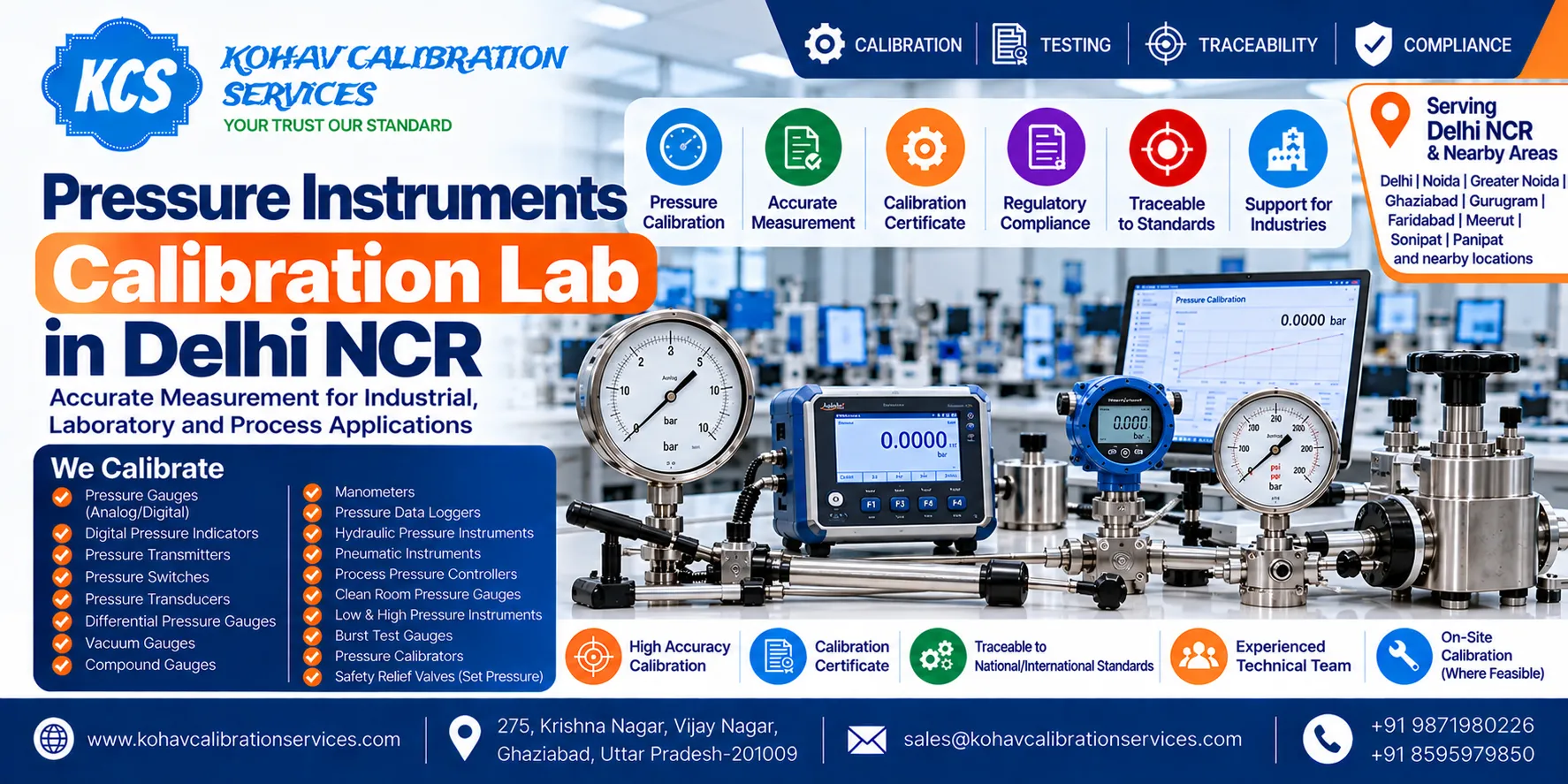
Kohav Calibration Services provides professional pressure instruments calibration services in Delhi NCR for manufacturing companies, process industries, engineering organizations, laboratories, pharmaceutical facilities, automotive industries, utilities, testing facilities and quality-control departments that depend on accurate pressure measurement.
Pressure measuring instruments are widely used for process monitoring, equipment testing, preventive maintenance, safety checks, quality control and industrial automation. Pressure measurement can be affected by mechanical wear, pressure cycling, vibration, temperature, over-range conditions and other operating factors.
Periodic calibration helps organizations evaluate the measurement performance of pressure instruments against appropriate reference standards and maintain documented measurement results.
For organizations searching for a Pressure Instruments Calibration Lab in Delhi NCR, Kohav Calibration Services focuses on instrument-specific requirements, controlled pressure measurement, suitable reference standards, calibration documentation and professional technical support.
What Is Pressure Instrument Calibration?
Pressure instrument calibration is a controlled process of comparing the indication or output of a pressure measuring instrument with an appropriate reference standard under defined conditions.
The purpose is to determine the relationship between the instrument indication and the reference pressure and to document the resulting measurement information.
Depending on the instrument and application, pressure calibration may involve hydraulic pressure, pneumatic pressure, vacuum or other applicable pressure ranges.
Calibration is different from repair or adjustment. Calibration determines measurement performance, while adjustment or repair changes the instrument’s performance where technically possible and appropriate.
Pressure Instruments Calibration Services in Delhi NCR
Kohav Calibration Services can support calibration requirements for pressure measuring instruments, subject to the applicable technical capability, measurement range and calibration scope.
Pressure instruments may include:
- Analog Pressure Gauges
- Digital Pressure Gauges
- Hydraulic Pressure Gauges
- Pneumatic Pressure Gauges
- Vacuum Gauges
- Compound Gauges
- Pressure Indicators
- Pressure Transmitters
- Pressure Transducers
- Pressure Switches
- Differential Pressure Instruments
- Digital Pressure Indicators
- Pressure Calibrators
- Pressure Test Gauges
- Other pressure measurement instruments
The exact instruments, pressure ranges, media, measurement points and calibration capabilities should be confirmed according to the applicable technical scope.
Pressure Gauge Calibration in Delhi NCR
Pressure gauges are widely used in industrial equipment, process systems, hydraulic systems, pneumatic systems, utilities and manufacturing operations.
A pressure gauge can develop measurement deviation because of mechanical wear, vibration, pressure shocks, repeated loading, temperature effects or other operating conditions.
Pressure gauge calibration compares the gauge indication with an appropriate reference pressure at defined measurement points.
Depending on the gauge and applicable procedure, calibration may evaluate readings during increasing and decreasing pressure conditions to identify relevant measurement behavior.
Hydraulic Pressure Gauge Calibration
Hydraulic pressure gauges are used in hydraulic machinery, presses, testing equipment, industrial systems and engineering applications.
Hydraulic pressure calibration requires suitable reference equipment and a controlled pressure source appropriate for the required range.
The calibration points should be selected according to the instrument range, accuracy requirement, applicable procedure and intended use.
Pneumatic Pressure Instrument Calibration
Pneumatic pressure instruments are commonly used in compressed-air systems, process equipment, automation and industrial applications.
Pneumatic calibration requires a suitable pressure source and reference standard appropriate for the required pressure range and measurement accuracy.
The calibration method should take into account the instrument type, pressure range and application requirements.
Vacuum Gauge Calibration
Vacuum gauges are used in applications where pressure below atmospheric pressure needs to be measured or monitored.
Vacuum measurement can be important in industries such as manufacturing, packaging, laboratories, process systems and industrial equipment.
Calibration of vacuum instruments should use appropriate reference standards and controlled conditions suitable for the required vacuum range.
Compound Pressure Gauge Calibration
Compound gauges are designed to measure both vacuum and positive pressure within their specified range.
Because compound gauges cover two measurement regions, calibration should consider the applicable vacuum and pressure portions of the instrument scale.
The exact calibration points and reference requirements depend on the gauge specification and applicable procedure.
Digital Pressure Gauge Calibration
Digital pressure gauges provide electronic pressure indication and are widely used in industrial and testing applications.
Calibration can help determine whether the digital indication remains within the required measurement limits.
The calibration requirement may depend on:
- Pressure range
- Display resolution
- Accuracy specification
- Pressure medium
- Operating conditions
- Required measurement uncertainty
- Intended application
Pressure Transmitter Calibration
Pressure transmitters convert pressure into an electrical output or other standardized signal for monitoring and control systems.
Depending on the transmitter configuration, calibration may involve checking the relationship between applied pressure and output signal.
Typical process-instrumentation signals can include current or voltage outputs, but the actual calibration requirement should be determined according to the transmitter design and customer specification.
For installed transmitters, on-site calibration may be considered where technically appropriate.
Pressure Switch Calibration
Pressure switches are used to initiate a control or safety action when pressure reaches a defined set point.
Calibration or verification of a pressure switch can involve checking relevant switching behavior against the applicable reference pressure.
Important parameters may include switching point, reset point, hysteresis or differential, depending on the instrument and application.
Differential Pressure Instrument Calibration
Differential pressure instruments measure the difference between two pressure points.
They may be used in process systems, filtration systems, HVAC applications, flow measurement and industrial equipment.
Calibration requirements depend on the differential pressure range, instrument configuration, accuracy requirement and intended application.
Why Pressure Instrument Calibration Is Important
Reliable pressure measurement is important for process control, equipment monitoring, maintenance and quality assurance.
Incorrect pressure measurement can affect operating decisions, process settings and equipment performance.
Regular calibration can help organizations:
- Maintain confidence in pressure measurements
- Identify measurement deviation
- Detect instrument drift
- Support process monitoring
- Maintain calibration records
- Improve measurement consistency
- Support quality-control procedures
- Meet customer requirements
- Support audits
- Establish measurement traceability where applicable
- Improve measuring-equipment management
For pressure-sensitive processes, calibration is an important part of a controlled measurement system.
Pressure Instrument Calibration Process at Kohav Calibration Services
A professional pressure calibration process should be systematic, controlled and appropriate for the instrument and measurement range.
1. Instrument Identification
The pressure instrument is identified using details such as manufacturer, model, serial number, asset number, pressure range and instrument type.
2. Visual and Functional Inspection
The instrument may be inspected for visible damage, dial condition, pointer movement, display condition, connections and other factors that could affect measurement.
3. Reference Standard Selection
A suitable pressure reference standard and pressure-generation system are selected according to the instrument type, pressure range, accuracy requirement and applicable procedure.
4. Zero Verification
Where applicable, the instrument’s zero indication is checked before pressure is applied.
5. Pressure Application and Measurement
Pressure is applied at defined measurement points and the instrument indication is compared with the applicable reference value.
6. Increasing and Decreasing Pressure Checks
Where applicable, readings may be evaluated during increasing and decreasing pressure cycles to identify relevant measurement behavior such as hysteresis.
7. Evaluation of Results
The observed readings are evaluated to determine applicable error, deviation, correction or other relevant measurement information.
8. Calibration Documentation
The applicable calibration results are documented in the relevant calibration report or certificate.
9. Calibration Status
Calibration status and records can be maintained to help organizations manage their pressure measuring equipment and future calibration requirements.
Pressure Calibration Certificate
A pressure calibration certificate should clearly identify the instrument and provide relevant information about the calibration performed.
Depending on the applicable service and reporting requirements, calibration documentation may include:
- Instrument name
- Manufacturer
- Model number
- Serial number
- Asset identification
- Pressure range
- Calibration date
- Calibration points
- Reference standards
- Applied pressure
- Instrument indication
- Measurement error or deviation
- Measurement uncertainty, where applicable
- Traceability information, where applicable
- Calibration method or procedure
- Relevant observations
Customers should verify that the reported pressure range and measurement parameters meet their actual requirement.
Measurement Traceability in Pressure Calibration
Measurement traceability is important when pressure measurement results need to be related to an appropriate reference through a documented chain of calibrations.
Pressure reference standards should be suitable for the required pressure range, measurement medium, accuracy and application.
The applicable traceability statement should correspond to the actual reference standards, calibration procedure and technical scope used for the service.
Organizations should verify the calibration provider’s specific accreditation scope and technical capability rather than assuming that every pressure range or instrument type is automatically covered.
Pressure Calibration Standards and Methods
Pressure calibration may use different reference and generation methods depending on the required pressure range and accuracy.
Possible reference systems can include suitable pressure calibrators, reference pressure gauges, pressure controllers, digital pressure standards, comparators and deadweight-based systems.
The appropriate method depends on:
- Pressure range
- Instrument type
- Required accuracy
- Pressure medium
- Measurement uncertainty
- Applicable calibration procedure
- Customer requirements
A technically appropriate reference should always be selected for the particular instrument and measurement range.
On-Site Pressure Instrument Calibration in Delhi NCR
Many pressure instruments are installed directly on machinery, pipelines, process equipment, hydraulic systems and industrial plants.
Removing such instruments for laboratory calibration may not always be practical.
Where technically appropriate, on-site pressure instrument calibration in Delhi NCR can help reduce transportation requirements and minimize equipment downtime.
On-site calibration may be considered for:
- Installed pressure gauges
- Process pressure indicators
- Pressure transmitters
- Pressure switches
- Large pressure instruments
- Difficult-to-transport equipment
- Process-connected instruments
The feasibility of on-site calibration depends on the instrument, pressure range, required uncertainty, environmental conditions, reference standards and applicable calibration procedure.
Industries Requiring Pressure Instrument Calibration in Delhi NCR
Pressure instruments are used across many industries and technical applications.
Kohav Calibration Services can support pressure calibration requirements for organizations operating in sectors such as:
Manufacturing Industry
Manufacturing plants use pressure gauges and pressure instruments for machinery, hydraulic systems, pneumatic systems and process monitoring.
Pharmaceutical Industry
Pressure measurement can be important in process equipment, utilities, cleanroom-related systems and manufacturing operations.
Automotive Industry
Automotive and auto-component facilities may use pressure instruments in hydraulic, pneumatic, testing and production equipment.
Chemical and Process Industries
Process plants use pressure instruments for monitoring and controlling industrial processes.
Oil and Gas Applications
Pressure measurement is widely used in equipment and process systems where controlled pressure monitoring is required.
Food and Beverage Industry
Pressure instruments may be used in processing equipment, utilities, compressed-air systems and other plant operations.
Power and Utility Operations
Pressure gauges and transmitters may be used in utility systems, equipment monitoring and maintenance applications.
Laboratories and Testing Facilities
Testing laboratories require reliable pressure measurement equipment and appropriate calibration records.
HVAC and Industrial Services
Pressure measurement can be used in air systems, refrigeration-related applications, filtration and industrial utilities.
Pressure Calibration Services Across Delhi NCR
Kohav Calibration Services can support organizations searching for pressure instruments calibration services in Delhi NCR, subject to service availability and the specific technical requirement.
Pressure calibration requirements can arise across:
- Delhi
- Noida
- Greater Noida
- Ghaziabad
- Faridabad
- Gurgaon
- Sahibabad
- Industrial areas across NCR
- Manufacturing clusters
- Laboratories
- Process plants
- Commercial and utility facilities
For organizations selecting a pressure calibration provider, geographical location is only one consideration. Technical capability, pressure range, reference standards, calibration method, documentation, traceability and applicable accreditation scope should also be evaluated.
How Often Should Pressure Instruments Be Calibrated?
There is no single calibration interval suitable for every pressure instrument.
Calibration frequency may depend on:
- Manufacturer recommendations
- Frequency of use
- Pressure cycling
- Instrument stability
- Previous calibration results
- Operating environment
- Exposure to vibration
- Over-pressure events
- Required measurement accuracy
- Measurement criticality
- Customer specifications
- Regulatory requirements
- Internal quality procedures
Organizations can review historical calibration results and instrument performance when establishing suitable calibration intervals.
What Happens If a Pressure Gauge Fails Calibration?
If a pressure instrument does not meet the applicable acceptance criteria, the organization may need to evaluate the instrument according to its internal procedure.
Possible actions may include:
- Adjustment, where technically possible
- Repair
- Recalibration after adjustment or repair
- Replacement
- Review of previous measurement results
- Evaluation of potential impact on products or processes
The appropriate action depends on the instrument, acceptance criteria, application and organizational quality procedure.
Calibration vs Adjustment
Calibration and adjustment are different activities.
Calibration determines and documents the relationship between the pressure instrument indication and the applicable reference value.
Adjustment changes the instrument’s performance so that its indication may be brought closer to the desired value, where technically possible and appropriate.
Therefore, a calibration service does not automatically mean that the pressure instrument has been adjusted or repaired.
Why Choose Kohav Calibration Services?
When selecting a Pressure Instruments Calibration Lab in Delhi NCR, organizations should consider technical capability, pressure range, reference standards, calibration procedures, documentation and applicable accreditation scope.
Kohav Calibration Services focuses on:
- Professional pressure calibration support
- Instrument-specific calibration requirements
- Controlled pressure measurement
- Calibration documentation
- Measurement-focused technical assistance
- Calibration record management
- Industrial and commercial calibration requirements
- Laboratory and on-site service options where technically applicable
- Support for organizations across Delhi NCR
Our objective is to help organizations maintain reliable pressure measuring equipment and make measurement-related decisions using documented calibration results.
What Information Is Required for Pressure Instrument Calibration?
To evaluate a pressure calibration requirement, customers should ideally provide:
- Instrument name
- Manufacturer
- Model number
- Serial number
- Asset or identification number
- Pressure range
- Pressure unit
- Instrument type
- Required accuracy
- Pressure medium
- Quantity
- On-site or laboratory requirement
- Specific standard or reporting requirement, if applicable
Providing complete instrument information helps determine the appropriate technical and service requirements before calibration.
Frequently Asked Questions
What is a pressure instruments calibration lab in Delhi NCR?
A pressure instruments calibration lab in Delhi NCR is a calibration facility that evaluates pressure measuring instruments by comparing their indications or outputs with appropriate reference standards under defined conditions and documenting the resulting measurement information.
Which pressure instruments can be calibrated?
Depending on the calibration provider’s technical capability and applicable scope, pressure calibration may include analog pressure gauges, digital pressure gauges, vacuum gauges, compound gauges, pressure indicators, pressure transmitters, pressure transducers, pressure switches and other pressure measuring equipment.
Why is pressure instrument calibration necessary?
Pressure calibration helps determine measurement error or deviation and provides documented information about an instrument’s measurement performance. It can support process control, maintenance, quality assurance, audits and measurement traceability.
How often should pressure gauges be calibrated?
The calibration interval depends on instrument stability, frequency of use, pressure cycling, operating environment, manufacturer recommendations, previous calibration history, measurement criticality and applicable quality or regulatory requirements.
Can pressure instruments be calibrated on-site in Delhi NCR?
For suitable instruments and applications, on-site calibration may be possible. Feasibility depends on the instrument, pressure range, required uncertainty, environmental conditions, reference standards and applicable calibration procedure.
What is the difference between pressure gauge calibration and adjustment?
Calibration determines the measurement performance of the pressure gauge against a reference. Adjustment changes the instrument’s performance where technically possible. Calibration does not automatically include adjustment.
Can pressure transmitters be calibrated?
Pressure transmitters can require calibration of the relationship between applied pressure and their specified output. The exact calibration method depends on the transmitter design, pressure range, output type and customer requirement.
What information is required for a pressure calibration quotation?
Provide the instrument type, manufacturer, model, pressure range, pressure unit, quantity, required accuracy and whether laboratory or on-site calibration is required. Additional technical information may be requested depending on the instrument.
What should I check before selecting a pressure calibration laboratory?
Check the laboratory’s applicable pressure-calibration capability, measurement range, reference standards, procedures, documentation, traceability information and accreditation scope for your specific pressure instrument and parameter.
Get Pressure Instrument Calibration Support in Delhi NCR
If you are searching for a Pressure Instruments Calibration Lab in Delhi NCR, Kohav Calibration Services can assist with pressure measurement and calibration requirements based on your instrument type, pressure range and intended application.
Whether you require calibration for pressure gauges, digital pressure indicators, vacuum gauges, pressure transmitters, pressure switches, pressure transducers or other pressure measuring instruments, the appropriate calibration service should be determined according to the instrument and applicable technical scope.
Contact Kohav Calibration Services with your instrument details to discuss the calibration requirement, service method, documentation and quotation.
Kohav Calibration Services
Pressure Instrument Calibration Services in Delhi NCR
Pressure Measurement | Calibration Documentation | Technical Support | Traceability Where Applicable