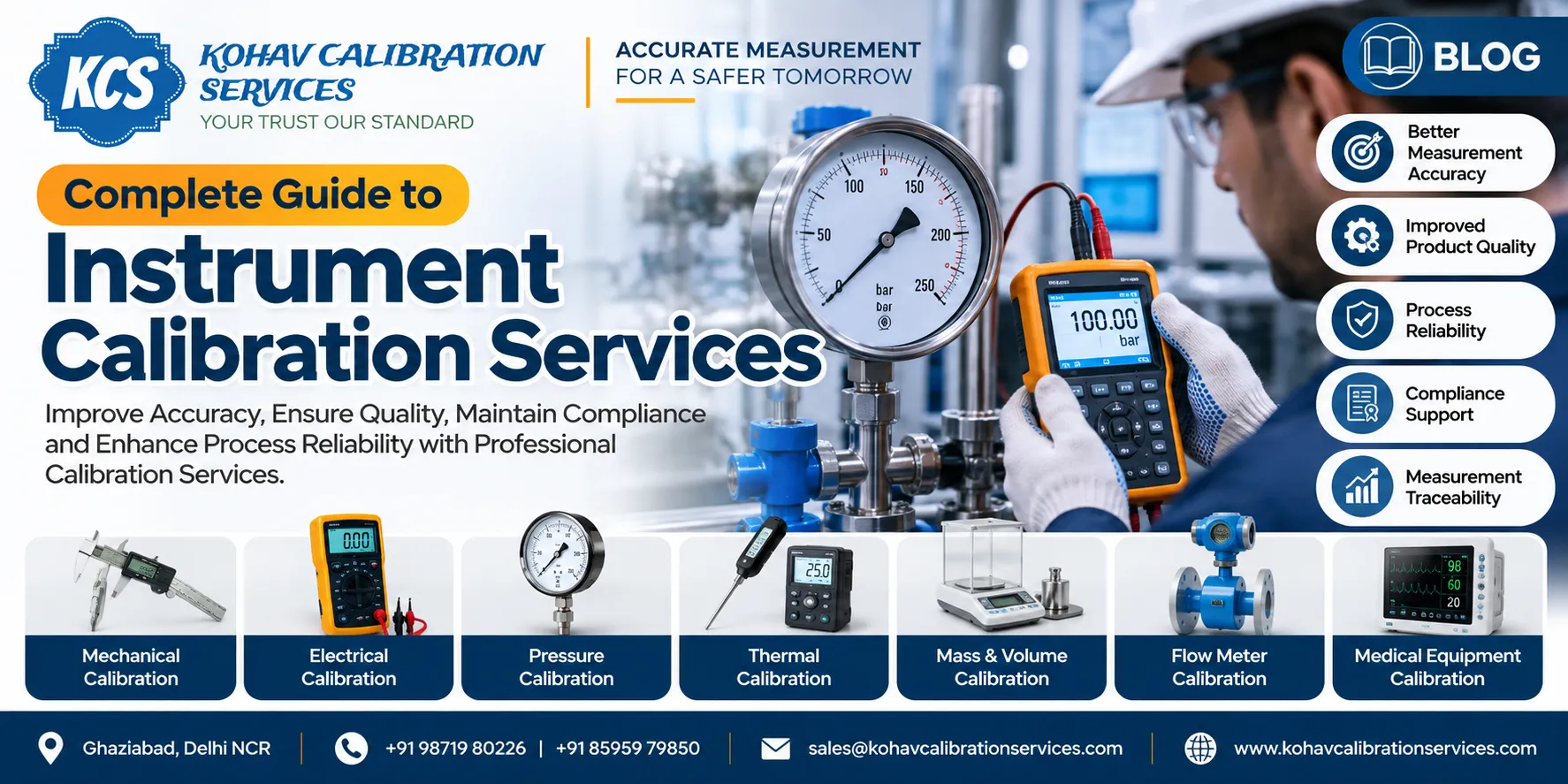
Instrument calibration services are an essential part of maintaining measurement accuracy, process consistency, product quality, and operational reliability across industries. Measuring instruments such as pressure gauges, weighing balances, thermometers, temperature sensors, multimeters, flow meters, torque tools, and medical equipment can develop measurement deviations over time due to regular use, environmental conditions, ageing, or mechanical stress.
Professional instrument calibration involves comparing an instrument’s readings with a known reference standard under defined conditions and documenting the measurement results. Depending on the instrument and calibration requirement, the process may also consider measurement uncertainty, traceability, calibration range, acceptance criteria, and the condition of the equipment.
For industries where measurement accuracy directly affects product quality, safety, compliance, or process performance, periodic calibration can help identify measurement errors before they create larger operational problems. Calibration records and certificates also provide documented evidence that an instrument has been evaluated against specified reference standards.
At Kohav Calibration Services, calibration requirements can vary according to the instrument type, measurement parameter, accuracy requirement, application, and operating environment. Services may cover mechanical, electrical, pressure, thermal, mass & volume, flow, and medical instruments, with laboratory and applicable on-site calibration requirements considered according to the equipment and service scope.
In this guide, we explain what instrument calibration is, why calibration is important, different types of calibration, the calibration process, calibration certificates, traceability, calibration frequency, on-site calibration, and how to select an appropriate calibration service provider in Delhi NCR.
Why Are Instrument Calibration Services Important?
1. Better Measurement Accuracy
A measuring instrument may continue to function while gradually developing measurement errors. Calibration helps identify these deviations.
For example, a pressure gauge showing a reading of 5 bar may not actually correspond to the reference pressure of 5 bar. Calibration determines the difference between the instrument indication and the reference value.
2. Improved Product Quality
Many manufacturing processes depend on accurate:
- Temperature
- Pressure
- Weight
- Dimension
- Flow
- Electrical measurements
- Volume
- Torque
- Force
Incorrect measurements can influence production decisions and product quality.
3. Process Control
Industrial processes frequently use instruments for monitoring and controlling operating conditions.
Calibrated instruments can provide more reliable information for process monitoring.
4. Quality-System Requirements
Organizations operating under formal quality-management systems often maintain records for their measuring equipment.
Calibration certificates can form part of an organization’s measurement-management documentation.
5. Measurement Traceability
Calibration can establish a documented relationship between an instrument’s measurement result and an appropriate reference standard.
Traceability is particularly important where measurements are used for quality, regulatory, laboratory or commercial purposes.
Types of Instrument Calibration
Instrument calibration covers many measurement disciplines.
Mechanical Instrument Calibration
Mechanical calibration can include:
- Vernier calipers
- Micrometers
- Dial indicators
- Height gauges
- Bore gauges
- Thread gauges
- Feeler gauges
- Thickness gauges
- Measuring tapes
- Surface plates
- Torque wrenches
- Mechanical gauges
Mechanical calibration is important for industries where dimensional accuracy and mechanical measurement are critical.
Electrical Instrument Calibration
Electrical calibration can include:
- Digital multimeters
- Analog multimeters
- Clamp meters
- Insulation testers
- Earth resistance testers
- LCR meters
- Power meters
- Energy meters
- Frequency meters
- Oscilloscopes
- Function generators
- Electrical sources
- Process calibrators
Electrical instruments should be evaluated according to their measurement parameters, ranges and intended applications.
Pressure Instrument Calibration
Pressure measurement is widely used in manufacturing, pharmaceuticals, chemical processing, utilities and process industries.
Common pressure instruments include:
- Pressure gauges
- Digital pressure indicators
- Pressure transmitters
- Pressure switches
- Pressure transducers
- Vacuum gauges
- Differential pressure gauges
- Compound gauges
- Pressure controllers
- Manometers
Thermal Instrument Calibration
Temperature measurement is critical in many industrial and laboratory applications.
Thermal calibration may include:
- Digital thermometers
- RTDs
- PT100 sensors
- Thermocouples
- Temperature indicators
- Temperature controllers
- Temperature transmitters
- Temperature switches
- Data loggers
- Infrared thermometers
- Thermo-hygrometers
Mass and Volume Calibration
Mass and volume measurement are particularly important in laboratories, pharmaceutical manufacturing, food processing and industrial production.
Common instruments include:
- Standard weights
- Analytical balances
- Precision balances
- Platform scales
- Weighing scales
- Pipettes
- Micropipettes
- Burettes
- Measuring cylinders
- Volumetric flasks
- Liquid-handling equipment
Flow Meter Calibration
Flow measurement is used in water treatment, chemical plants, pharmaceutical facilities, manufacturing and utility systems.
Flow instruments may include:
- Water flow meters
- Electromagnetic flow meters
- Ultrasonic flow meters
- Turbine flow meters
- Coriolis flow meters
- Rotameters
- Gas flow meters
- Mass flow meters
- Flow transmitters
- Flow switches
Medical Equipment Calibration
Healthcare facilities also depend on accurate measuring equipment.
Depending on technical capability, medical calibration may involve:
- Patient monitors
- ECG machines
- Pulse oximeters
- BP monitors
- Infusion pumps
- Syringe pumps
- Ventilators
- Medical thermometers
- Medical weighing equipment
- Defibrillators
- Medical pressure instruments
Medical equipment calibration should be performed according to the applicable equipment specifications, procedures and requirements.
How Does Instrument Calibration Work?
A typical calibration process includes several stages.
Step 1: Instrument Identification
The instrument is identified using:
- Manufacturer
- Model
- Serial number
- Range
- Accuracy class
- Instrument type
Step 2: Technical Review
The calibration requirement is reviewed to determine:
- Measurement parameter
- Required range
- Calibration points
- Applicable method
- Acceptance criteria
Step 3: Reference Standard Selection
A suitable reference standard is selected according to the instrument and required measurement range.
Step 4: Controlled Measurement
The instrument is tested at selected points under defined conditions.
Step 5: Results Recording
The reference readings and instrument readings are recorded.
Step 6: Error Calculation
The difference between the reference value and instrument indication is evaluated.
Step 7: Uncertainty Evaluation
Where applicable, measurement uncertainty is considered when reporting calibration results.
Step 8: Certificate Preparation
The calibration results are documented in a calibration certificate or report.
What Is a Calibration Certificate?
A calibration certificate is a formal document containing information about the calibration performed on an instrument.
Depending on the calibration service, it may include:
- Customer name
- Instrument identification
- Manufacturer
- Model number
- Serial number
- Calibration date
- Measurement range
- Calibration points
- Reference standards
- Observed readings
- Error or deviation
- Measurement uncertainty
- Calibration method
- Environmental conditions where relevant
- Results
- Calibration status
Organizations should verify that the certificate contains the information required by their internal quality procedures or applicable standards.
What Is Measurement Traceability?
Measurement traceability means establishing a documented chain connecting a measurement result to an appropriate reference through a series of comparisons.
STQC explains that traceability provides a link between day-to-day measurement data and recognized national measurement standards.
When evaluating a calibration laboratory, organizations should consider:
- Reference standards
- Calibration status of reference equipment
- Measurement uncertainty
- Calibration method
- Measurement range
- Technical competence
- Applicable accreditation scope
What Is ISO/IEC 17025?
ISO/IEC 17025 is an international standard related to the competence of testing and calibration laboratories.
Laboratories operating under an accreditation framework are assessed against defined requirements for competence and laboratory operations.
However, accreditation should always be evaluated according to the specific scope.
A laboratory being accredited does not automatically mean that every instrument, parameter, range or calibration method is covered.
Customers requiring accredited calibration should check the current accreditation certificate and exact scope applicable to their instrument.
On-Site Instrument Calibration Services
Some instruments are difficult to remove from their installed location.
Examples include:
- Large industrial gauges
- Installed pressure transmitters
- Flow meters
- Fixed temperature systems
- Industrial weighing systems
- Panel-mounted electrical instruments
- Process-control instruments
Where technically feasible, on-site calibration can reduce equipment removal and process interruption.
On-site calibration requirements depend on the instrument type, installation arrangement, measurement range, accessibility, safety conditions and availability of suitable reference equipment.
Delhi NCR calibration providers also advertise on-site or workshop calibration for pressure, temperature and flow instruments, demonstrating the importance of flexible service arrangements for industrial customers.
Laboratory Calibration vs On-Site Calibration
Laboratory Calibration
Laboratory calibration may be suitable when:
- The instrument can be removed
- Controlled conditions are required
- Specialized reference equipment is needed
- Detailed laboratory measurement is preferred
On-Site Calibration
On-site calibration may be useful when:
- Equipment is permanently installed
- Removal causes production downtime
- The instrument is large or difficult to transport
- Process conditions need to be considered
The appropriate option depends on the specific instrument and calibration requirement.
How Often Should Instruments Be Calibrated?
There is no single calibration interval that applies to every measuring instrument.
The calibration interval can depend on:
- Manufacturer recommendations
- Frequency of use
- Instrument stability
- Operating environment
- Measurement criticality
- Previous calibration results
- Regulatory requirements
- Internal quality procedures
- History of repair or adjustment
Organizations should establish calibration intervals based on their measurement-control requirements and historical instrument performance.
What Happens If an Instrument Fails Calibration?
If an instrument does not meet the required acceptance criteria, the result should be evaluated according to the organization’s quality procedure.
Possible actions may include:
- Adjustment
- Repair
- Recalibration
- Replacement
- Investigation of previous results
- Impact assessment
- Corrective action
For critical instruments, an out-of-tolerance result may require review of measurements made since the previous acceptable calibration.
Calibration vs Adjustment
Calibration and adjustment are different activities.
Calibration determines the relationship between the instrument reading and the reference value.
Adjustment changes the instrument’s performance so that its indication can be brought closer to the required value.
An instrument can therefore be calibrated without being adjusted.
If an adjustment is performed, a subsequent calibration may be required to document the resulting performance.
How to Choose an Instrument Calibration Laboratory
Selecting a calibration laboratory should be based on technical requirements rather than location alone.
Consider the following:
Technical Scope
Check whether the laboratory covers your:
- Instrument type
- Parameter
- Measurement range
- Accuracy requirement
- Calibration method
Traceability
Ask how the reference standards used for calibration are maintained and how measurement traceability is established.
Measurement Uncertainty
For critical applications, understand the measurement uncertainty associated with the calibration results.
Certificate Requirements
Ensure that the calibration certificate contains the information required for your quality system.
On-Site Capability
If your equipment cannot be removed, confirm whether on-site calibration is technically feasible.
Accreditation Scope
If accredited calibration is required, verify the laboratory’s current accreditation certificate and exact scope rather than relying only on a general accreditation claim.
Instrument Calibration Services in Delhi NCR
Delhi NCR has a significant industrial and manufacturing ecosystem, creating demand for calibration of mechanical, electrical, pressure, thermal, mass, volume and process instruments.
Calibration services are relevant to organizations in:
- Delhi
- New Delhi
- Noida
- Greater Noida
- Ghaziabad
- Faridabad
- Gurugram
- Sahibabad
- Manesar
- Okhla
- Bawana
- Mayapuri
- Naraina
- Patparganj
- Wazirpur
- Jhilmil Industrial Area
- Other nearby industrial areas
Several calibration laboratories serving Delhi NCR publish capabilities covering multiple measurement disciplines, including electrical, mechanical, pressure, thermal, mass and volumetric calibration.
Industries That Need Instrument Calibration
Calibration is relevant across many industries.
Pharmaceutical Industry
Pharmaceutical manufacturing relies on controlled measurement of temperature, pressure, weight, volume and other parameters.
Food and Beverage Industry
Food-processing operations use weighing, temperature, pressure and flow instruments throughout production and quality control.
Chemical Industry
Chemical processes frequently depend on pressure, temperature, flow and other process measurements.
Automotive Industry
Automotive manufacturing uses dimensional, torque, force, pressure and electrical measuring instruments.
Engineering and Manufacturing
Engineering plants use mechanical and electrical measuring instruments for production and inspection.
Hospitals and Healthcare
Healthcare facilities use medical measurement equipment that may require periodic performance evaluation and calibration.
Laboratories
Laboratories depend on accurate measurement instruments for testing, analysis and research.
Why Choose Kohav Calibration Services?
Kohav Calibration Services provides calibration support for industrial, laboratory and medical measuring instruments.
Our service categories include:
- Mechanical Instruments Calibration
- Electrical Instruments Calibration
- Pressure Instruments Calibration
- Thermal Instruments Calibration
- Mass Calibration
- Volume Calibration
- Flow Meter Calibration
- Energy Meter Calibration
- Medical Equipment Calibration
The calibration approach is selected according to the instrument type, measurement range, application and applicable technical requirements.
Customers requiring accredited calibration should verify the current accreditation status and exact scope applicable to their specific requirement.
Frequently Asked Questions
What is instrument calibration?
Instrument calibration is the comparison of a measuring instrument against a suitable reference standard under defined conditions to determine its measurement performance.
Why is instrument calibration required?
Calibration helps organizations identify measurement deviations, maintain reliable measurement records and support quality and process-control requirements.
Which instruments require calibration?
Mechanical, electrical, pressure, thermal, mass, volume, flow and medical measuring instruments may require calibration depending on their application and quality requirements.
How often should instruments be calibrated?
The interval depends on the instrument, application, manufacturer recommendations, operating conditions, historical performance and applicable quality or regulatory requirements.
What is a calibration certificate?
A calibration certificate documents the instrument identification, calibration conditions, measurement results and other relevant technical information.
What is traceability in calibration?
Traceability is the documented relationship between a measurement result and an appropriate reference standard through an established chain of comparisons.
Can calibration be performed on site?
Yes, on-site calibration may be possible for suitable instruments where technical conditions and reference equipment permit.
Does calibration mean adjustment?
No. Calibration evaluates measurement performance. Adjustment changes the instrument’s performance and may be followed by recalibration.
How do I select a calibration laboratory?
Consider technical scope, measurement range, calibration method, uncertainty, traceability, documentation, on-site capability and applicable accreditation scope.
Conclusion
Instrument calibration is an important part of reliable measurement management. Regular calibration helps organizations understand the performance of their measuring equipment and identify deviations before they affect critical processes.
From mechanical instruments and electrical meters to pressure gauges, temperature sensors, weighing equipment, flow meters and medical devices, the right calibration approach depends on the instrument, application and required measurement range.
Kohav Calibration Services supports organizations looking for instrument calibration services in Delhi NCR, including Delhi, Noida, Ghaziabad and surrounding industrial areas.
For calibration requirements, customers can provide the instrument name, manufacturer, model, serial number, range, quantity and location to determine the appropriate service requirement.